Sunderland Dogs Fixtures and Schedule: Race Days, Times and BAGS Meetings
Best Greyhound Betting Sites – Bet on Greyhounds in 2026
 Available in US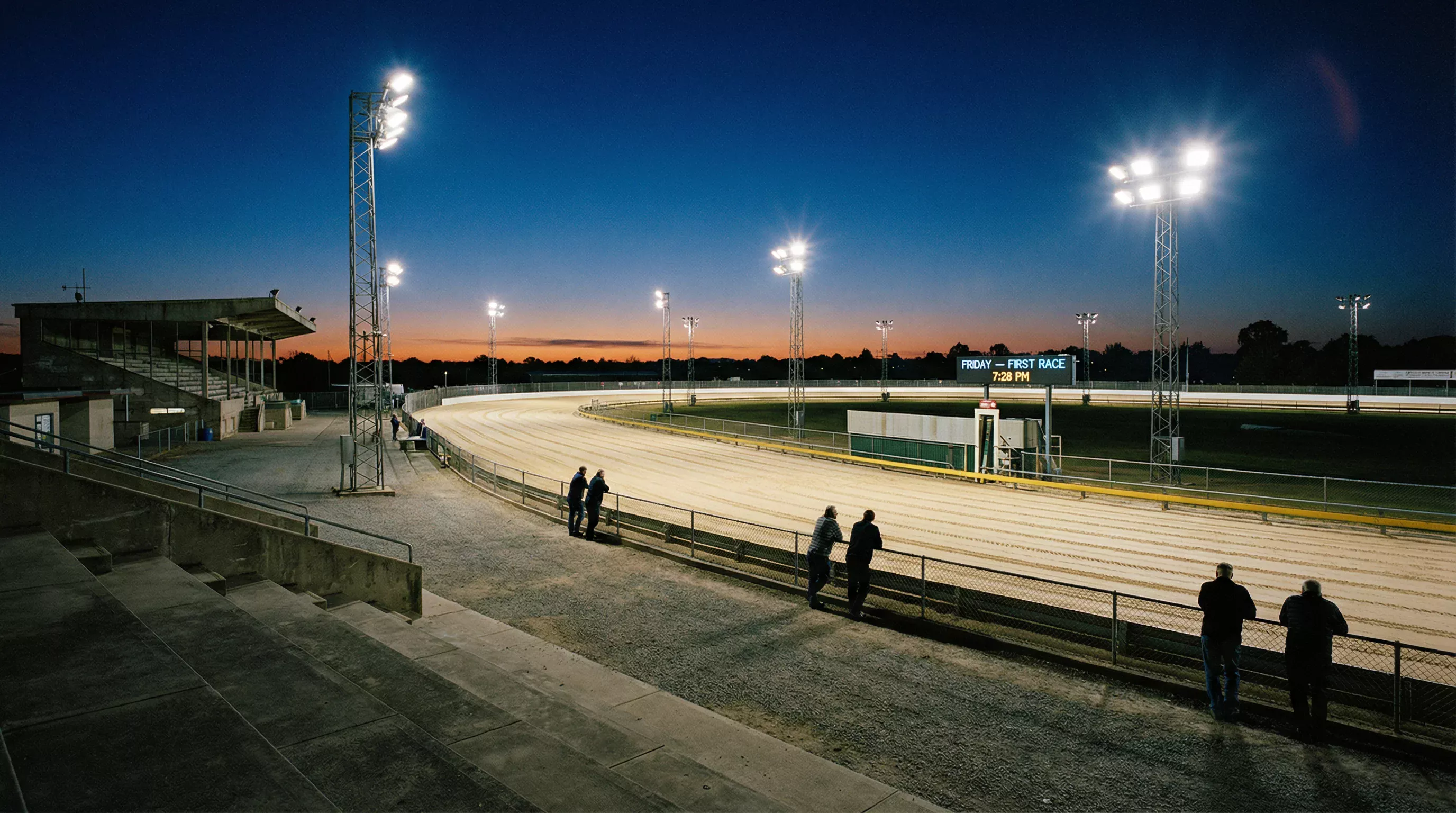
Introduction
Sunderland Greyhound Stadium runs four meetings every week, which puts it among the busiest tracks in the north of England and makes its fixture list one of the more complex schedules in GBGB-licensed racing. Four meetings does not mean four identical evenings. The days, the start times, the target audiences and the commercial structures behind each fixture are all different, and the reasons for those differences run deeper than scheduling convenience.
Three of Sunderland’s four weekly fixtures serve the Bookmakers’ Afternoon Greyhound Service — BAGS — which supplies live racing content to betting shops and online platforms across the UK. The fourth, the Friday night meeting, is an open-attendance event aimed at trackside spectators rather than off-course bettors. That split shapes everything from the race times to the grade of competition on the card. Sunderland’s racing calendar decoded starts with understanding that the stadium is operating two distinct businesses simultaneously: a content supplier for the national betting market and a live entertainment venue for the north-east.
Joanne Wilson, General Manager at the stadium, has described the annual fixture list as offering “a strong mix of graded, open and competition races for racegoers to enjoy.” That variety is not accidental — it is the product of contractual obligations to BAGS, the ambitions of the ARC Grand Prix and Classic programmes and the practical need to keep the local racing community engaged week after week. This guide maps out how Sunderland’s schedule works, why each meeting exists and what it means for anyone planning to attend, watch or bet.
Weekly Schedule — Monday, Wednesday, Friday and Sunday
Sunderland’s four weekly fixtures follow a consistent pattern across the season. The days are Monday, Wednesday, Friday and Sunday. The format of each day is broadly fixed, though individual race times shift slightly depending on sunset, broadcast windows and seasonal adjustments.
Monday — Daytime BAGS. The first meeting of the week is a daytime fixture, with the first race typically going off in the early afternoon — around 13:57 or 14:11, depending on the specific scheduling slot allocated by the BAGS rota. Monday meetings are pure content fixtures: the audience is almost entirely off-course, watching through betting-shop screens, online streams and SIS feeds. The crowd trackside is minimal, sometimes numbering in the low dozens, and the atmosphere is functional rather than electric. The racing itself is standard graded fare — a programme of ten to twelve races across the 450-metre and 640-metre distances, occasionally supplemented by a sprint or a longer trip. For bettors, Monday meetings at Sunderland offer competitive fields without the chaos of a big-night crowd or the distortions that open races can introduce to a grading pool.
Wednesday — Daytime BAGS. Structurally almost identical to Monday. The first race goes off in the early afternoon. The card is again predominantly graded racing at 450 and 640 metres, with the same BAGS broadcast window. Wednesday tends to mirror Monday in quality of field because the same resident kennels supply dogs to both meetings. If you are comparing form across multiple Sunderland fixtures, Monday and Wednesday results are the most directly comparable — same conditions, same track preparation, similar race times, similar grade levels.
Friday — Evening meeting. This is the flagship fixture of Sunderland’s week and the only regularly scheduled evening meeting. The first race typically starts between 18:00 and 18:30, and the programme runs through until around 21:30 or 22:00. Friday night is the meeting that draws the trackside crowd — groups, couples, families, stag parties, corporate hospitality bookings and regulars who treat it as a weekly social fixture. The card reflects the elevated audience: Friday often features higher-graded races, open events and occasionally rounds of the ARC Grand Prix or Classic competitions when the seasonal calendar demands it. Betting volumes are higher on Friday nights, partly because of the trackside tote and partly because the off-course market treats the evening meeting as a premium BAGS slot with better television scheduling.
Sunday — Morning BAGS. The most unusual of Sunderland’s four meetings in terms of timing. Sunday fixtures start early — first race as soon as 10:55 in some scheduling windows — and cater to the morning betting-shop market. The feel is different from any other day of the week: the track is quieter, the sand is freshly maintained after a Saturday without racing and the card is designed to fill the morning void before horse racing takes over the afternoon. For form students, Sunday Sunderland meetings are worth monitoring because the early start time can affect how dogs perform. Some trainers report that their charges run differently in the morning — less sharp in the traps but more relaxed through the bends — though this is anecdotal rather than data-driven.
Across all four days, the race distances are drawn from Sunderland’s four-trip menu: 261 metres (sprint), 450 metres (standard), 640 metres (stayers) and 828 metres (marathon). The standard distance dominates every meeting. Sprints and marathons are rarer and tend to appear on specific cards when the grading programme requires it. Friday nights are more likely to feature variety in distances, partly to offer the trackside audience a more visually diverse evening and partly because open races may be set at non-standard trips.
How BAGS Drives the Sunderland Calendar
To understand why Sunderland races four times a week — and why three of those meetings happen during the daytime — you need to understand BAGS. The Bookmakers’ Afternoon Greyhound Service is the commercial engine that keeps the majority of UK greyhound stadiums financially viable. It is not a broadcaster, not a bookmaker and not a governing body. It is a content-supply agreement: stadiums provide live racing, and bookmakers pay for the right to offer betting markets on that racing in their shops and on their websites.
The scale of BAGS is substantial. According to Towcester Racecourse’s overview of the service, approximately 5,772 greyhounds take part in 74 BAGS meetings every week across the UK, and the service pays around £26 million per year to contracted stadiums. That weekly figure — 74 meetings — means the betting-shop screens carry near-continuous greyhound racing throughout the day, with races going off at intervals as short as three or four minutes when multiple stadiums are running simultaneously. The greyhound is not competing with horse racing for afternoon attention; it is filling the gaps that horse racing leaves, and it is doing so on a factory scale.
Sunderland’s place in this ecosystem is defined by its relationship with Arena Racing Company, which owns the stadium and operates it as part of a wider group. ARC signed an agreement with BAGS through the GMG (Greyhound Media Group) structure, committing a minimum of 1,619 fixtures per year across twelve stadiums, including Sunderland. Divided across twelve venues, that works out to roughly 135 fixtures per stadium per year — a figure that aligns closely with Sunderland’s four-meetings-per-week schedule across the calendar.
What does BAGS mean for the racing itself? Primarily, it means that Sunderland’s Monday, Wednesday and Sunday meetings exist to serve an off-course audience rather than a trackside one. The races are scheduled to slot into the national BAGS rota — a master timetable that ensures no two stadiums have races going off at the same time. This coordination is essential for the betting-shop model, where a single screen might cycle through six or seven tracks in an afternoon and each race needs its own uncontested broadcast window. Sunderland’s 13:57 or 14:11 start times are not arbitrary; they are scheduled around the output of other tracks in the rota.
BAGS also affects the type of racing on the card. Because the primary commercial purpose is to generate betting content, BAGS meetings tend to feature competitive graded races where the form is readable and the betting market can price each runner meaningfully. Open races, novelty events and experimental formats are less common on daytime BAGS cards because they make the betting market harder to price and reduce bookmaker margins. This is why Friday night — the non-BAGS fixture in spirit, even though it is technically broadcast and bet on — carries a different flavour of racing. The evening meeting can afford to be more varied because its commercial model does not depend entirely on off-course betting volume; it also generates income through gate receipts, hospitality packages, tote turnover and bar sales.
For the bettor sitting at home, the BAGS structure creates a paradox. The meetings that exist specifically to serve you — the daytime fixtures — are the ones where the racing is most standardised and the form is most readable. The Friday night meeting, designed for the live crowd, is less predictable because open races and higher-grade contests introduce greater variability. If your approach to Sunderland is data-driven, the Monday, Wednesday and Sunday cards are actually the most fertile ground for systematic form analysis.
Friday Night vs Daytime BAGS — Atmosphere and Betting Differences
Walk into Sunderland Greyhound Stadium on a Monday afternoon and you will find a handful of diehards in the stands, a quiet tote window and dogs racing under daylight for an audience that is mostly watching through screens elsewhere. Walk in on a Friday night and the place is a different animal. The floodlights change the visual texture of the track; the sand looks sharper, the dogs’ jackets brighter, the finish line more dramatic. The restaurant is full, the bar is busy and the crowd generates noise that the daytime meetings simply cannot produce.
That atmospheric difference is not just cosmetic — it filters into the betting market. On a daytime BAGS card, the market is driven by professional and semi-professional bettors sitting at home with form data open on their screens. Prices are sharp, movements are logical and the favourite tends to be correctly identified. The UK-wide favourite strike rate in graded races sits at around 35.67%, and on typical BAGS cards that figure holds fairly steady because the market is efficient. On Friday nights at Sunderland, the market is diluted by casual money. Racegoers who have come for the evening out will back a dog because they like the name, the colour or the trap number. That influx of uninformed money can push the favourite to shorter prices than its form deserves or, more usefully, let a genuine contender drift in the market because nobody at the bar has checked its sectional times.
The racing programme itself differs too. Friday night cards at Sunderland often feature higher-graded races and may include open events that attract dogs from outside the stadium’s regular kennel pool. An open race resets the normal grading structure: instead of six dogs drawn from the same grade band, you get six dogs selected on the basis of time and trial performance, sometimes from different tracks entirely. That makes the form more complex to assess but also increases the chance of finding a mispriced runner, because the market is less certain about dogs it has not seen at Sunderland before.
For bettors who approach greyhound racing as an analytical exercise, the daytime BAGS meetings are more predictable — which is not a criticism but a description. Predictability is where systematic methods thrive. The fields are graded, the dogs are familiar, the times are trackable and the market is priced by people who have done the work. If you prefer pattern recognition, consistent data and small edges accumulated over hundreds of races, Monday, Wednesday and Sunday at Sunderland are your working days.
Friday night is the opposite. It rewards flexibility, race-reading and the ability to spot value created by the casual-money distortions in the market. It is also just more enjoyable as an experience — the collective groan when a favourite gets bumped at the second bend, the roar when a 10/1 outsider leads off the final turn, the brief silence while the photo-finish is called. The schedule at Sunderland is built so that both types of racing coexist, each serving a different audience and a different type of engagement.
Seasonal Calendar — Category One Events and Holiday Fixtures
The weekly four-meeting rhythm at Sunderland is punctuated by a handful of events that break the pattern and elevate the quality of racing above the regular graded programme. The two most significant are the ARC Grand Prix and the ARC Classic, both of which hold Category One status — the highest classification in UK greyhound racing, equivalent to a Group One in horse racing terms.
The ARC Grand Prix is typically held in April. It carries a prize fund of £12,500 to the winner and runs over the 640-metre stayers distance. The competition is structured as a series of heats, semi-finals and a final, spread across multiple weeks. Qualifying heats are seeded from open trials, meaning any greyhound in the country can enter subject to meeting the time standard. The Grand Prix transforms Sunderland from a regional fixture into a national stage: trainers from southern England, the Midlands and the wider north will ship dogs to Sunderland specifically for this competition. The final night typically draws the largest crowd of the year and generates the highest single-meeting tote turnover. For the bettor, Grand Prix heats and semis are among the trickiest races on the Sunderland calendar because the fields include unfamiliar dogs with limited local form.
The ARC Classic follows a similar structure but is scheduled for November, providing a bookend to the competitive season. It carries equivalent prestige and draws a comparable field. Together, the Grand Prix and Classic give Sunderland two periods each year when the stadium’s profile rises nationally and when the regular grading programme is adjusted to accommodate the competition schedule. During Grand Prix and Classic weeks, some regular graded races are displaced or rescheduled to free race slots for heats and semis.
Beyond the Category One events, Sunderland hosts a rotation of smaller open competitions throughout the year. Puppy derbies for younger greyhounds making their competitive debuts, stayers’ events over 640 metres and occasional sprint championships over 261 metres all appear on the fixture calendar. These events are typically advertised weeks in advance and may require entries by a specific deadline, which means the racecard for those meetings looks different from a standard BAGS card — the fields are hand-picked rather than graded, and the dogs may include visiting runners from other ARC stadiums.
Holiday fixtures add another layer to the seasonal calendar. Bank holiday Mondays, Boxing Day and New Year are all dates when Sunderland often runs enhanced meetings — sometimes with increased prize money, sometimes with a modified schedule that adds an extra fixture to the normal week. Boxing Day greyhound racing has a long tradition across the UK, and attendance figures at ARC stadiums suggest the public appetite for holiday meetings is growing. Arena Racing Company reported significant footfall increases at several of its tracks during 2025 festive events, with one venue seeing a rise of more than 300% on its PGR Oaks finals night and Newcastle posting an 85% increase on its finals evening. While Sunderland’s specific figures are not published separately, the broader ARC trend suggests that holiday fixtures at the stadium are drawing bigger crowds than in previous years.
For planning purposes, the seasonal calendar at Sunderland divides roughly into four phases: the spring build-up toward the Grand Prix (February to April), the summer programme of regular graded racing and puppy competitions (May to August), the autumn lead-in to the Classic (September to November) and the festive period (December to January). Each phase has a distinct character, and knowing where you are in that cycle helps you interpret the racecard. A dog’s form in the weeks before the Grand Prix, for instance, may be affected by a trainer’s decision to rest or trial it rather than race it competitively, which can produce misleading form figures.
Planning Your Visit Around the Schedule
If you are visiting Sunderland Greyhound Stadium for the first time, the schedule itself is your most important planning tool. Choose the wrong day and you will have a perfectly fine time but miss the experience you were expecting. Choose the right day and the evening writes itself.
For a social night out — a birthday, a group event, a date or simply an evening of entertainment — Friday is the only sensible choice. The atmosphere, the hospitality packages, the crowd energy and the quality of racing all peak on Friday night. Gates typically open an hour or so before the first race, giving time to find your seat, order food if you have booked a restaurant package and study the racecard before the action starts. Friday evening meetings also offer the widest range of distances on the card, which keeps the visual variety high: sprints are fast and chaotic, stayers races build through four bends and marathons test both the dogs and the crowd’s attention span.
For a quieter, more analytical visit — the kind where you want to sit with the racecard, watch the dogs in the parade ring and study the early pace without distraction — Monday or Wednesday daytime meetings are ideal. You will not fight for a spot at the rail, the tote queues are short and you can watch the racing at your own pace. Sunday morning is similar in character but the earlier start time requires commitment.
Timing your visit around the seasonal calendar adds another dimension. If you want to see the best racing Sunderland offers, target the Grand Prix in April or the Classic in November. These events attract the strongest fields and the largest crowds. If you prefer a standard evening without the intensity of a national competition, any non-event Friday will deliver a solid night of graded racing and a sociable atmosphere.
One practical note: Sunderland’s fixture list is published in advance on the stadium’s official website and updated periodically through the season. Fixtures can be rescheduled for weather, track maintenance or scheduling conflicts within the BAGS rota, so checking the website in the week before your planned visit is worth the thirty seconds it takes. Turning up on the wrong day is a mistake that a quick glance at the fixture list prevents entirely.
Sunderland Dogs Fixtures and Schedule — More on this topic at sunderland dogs results.
See also Sunderland Greyhound Betting.
