Sunderland Greyhound Betting: Odds, Track-Specific Tips and Staking Strategies
Best Greyhound Betting Sites – Bet on Greyhounds in 2026
 Available in US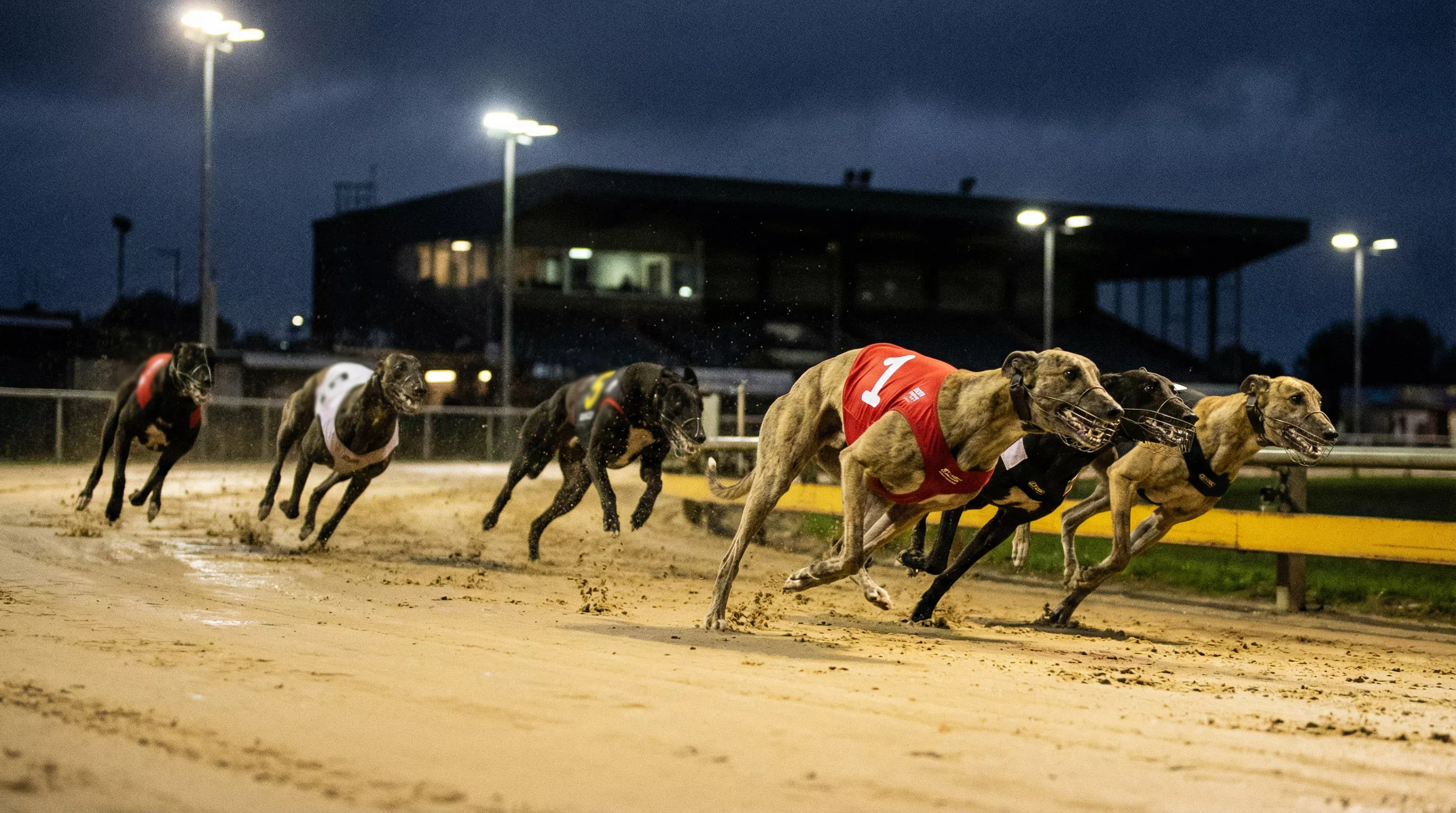
Introduction
Most greyhound betting advice is generic. It tells you to study form, back the favourite and manage your money — advice that applies equally to Sunderland, Romford and a track you have never heard of. The problem is that greyhound tracks are not interchangeable. Each has its own geometry, surface, trap bias profile and competitive depth, and a strategy that works at one venue may be irrelevant at another. This guide is about betting edges at this specific track — Sunderland Greyhound Stadium — and what its data tells you that a one-size-fits-all tip sheet cannot.
Greyhound racing occupies a significant slice of the UK betting market. Mark Kingston, Director of Premier Greyhound Racing, has described the sport’s role bluntly: “As important as greyhound racing is to the betting industry as a whole, greyhounds have always been a fundamental part of the betting shop service.” That relationship between bookmaker and track is the commercial foundation on which Sunderland’s four-meeting weekly schedule rests, and it means the betting markets on Sunderland races are deep, liquid and — if you know where to look — exploitable.
What follows is not a list of picks. It is a framework: how the track’s physical characteristics influence race outcomes, why Sunderland’s trap data demands a different approach from most UK venues, what the favourite win rate actually tells you and how different bet types interact with the specific patterns this stadium produces. The data comes from verified sources. The strategy is built on that data rather than hunches.
Track Characteristics That Shape Odds
Before you look at a single dog on the racecard, the track itself has already shaped the odds. Every greyhound stadium has a physical profile — circumference, surface, hare type, run to the first bend, number of bends per distance — and each of those variables creates conditions that suit some dogs and disadvantage others. At Sunderland, these characteristics are well-documented.
The track has a circumference of approximately 378 metres, an all-weather sand surface and an Outside McGee hare system. Four distances are in regular use: 261 metres (sprint), 450 metres (standard), 640 metres (stayers) and 828 metres (marathon). The standard 450-metre trip is the workhorse of the racing programme and generates the most betting volume. At this distance, the run to the first bend is 93 metres — long enough to give early-pace dogs an opportunity to establish position before the turn but short enough to punish those that break slowly.
The all-weather sand surface is the variable that most bettors underrate. Sand does not ride like grass, and it does not ride like the Thistle dirt surfaces found at some other UK venues. Sand offers consistent grip in most weather conditions, which reduces the number of slip-based incidents and makes times more comparable from one meeting to the next. For the bettor, that consistency is gold. Calculated times at Sunderland are more reliable as comparative tools than at tracks where surface conditions change dramatically between meetings. If a dog clocked 27.90 at Sunderland last Wednesday, that time is likely to be a reasonable indicator of what it can do this Friday — a statement you cannot always make at venues with variable going.
The Outside McGee hare system also matters, though its impact is less intuitive. An outside-running hare means dogs naturally gravitate toward the outside rail as they chase, which distributes the pack more evenly across the width of the track compared to an inside-running hare where the field compresses toward the inner rail. At Sunderland this contributes to the track’s reputation for fairness: crowding incidents on the bends are less severe than at some inside-hare stadiums, which means form is more often a genuine reflection of ability rather than a product of interference and luck.
The 640-metre distance introduces an additional variable. At this trip the run to the first bend is 84 metres — shorter than at 450 metres — which compresses the early exchanges and makes the first bend more significant tactically. For bettors, the 640-metre trip at Sunderland tends to produce more surprises than the standard distance because positional luck on the first turn has a proportionally greater influence. Dogs with early pace and an inside trap draw have a sharper advantage at 640 metres than at 450, simply because the window for establishing rail position is narrower.
Understanding these characteristics before you engage with form or odds is the first step in building a track-specific approach. The physical layout of Sunderland favours dogs with consistent early pace, dogs that handle sand well and dogs whose form is built at this venue rather than imported from tracks with different geometries. None of that is visible in the odds unless you look for it.
Trap Strategy at a Fair Track
At most UK greyhound stadiums, trap bias is a betting factor you can measure and exploit. The inside boxes — Trap 1 and Trap 2 — tend to produce a disproportionately high percentage of winners because the shorter path to the rail gives inside runners a structural advantage through the bends. Across British tracks, Trap 1 averages a win rate of roughly 18–19% against a theoretical expectation of 16.67%. That two-to-three-percentage-point edge, compounded over hundreds of races, is significant enough to build a simple system around.
Sunderland breaks that pattern. Data from Greyhound Stats UK shows that each trap at the stadium wins approximately 17% of races — almost exactly in line with the mathematical expectation for a six-runner contest. The inside-rail advantage that exists at other venues is minimal here. No single trap is a reliable system bet on its own, and no single trap is a consistent avoid.
For the lazy bettor, this is bad news. The shortcut of backing Trap 1 with a small edge does not work at Sunderland. For the analytical bettor, it is actually better news than it appears. A fair track means the market has one fewer structural factor to lean on, which increases the relative importance of form, sectional data and trainer patterns. At a biased track, the market can price in the trap advantage automatically — bookmakers’ algorithms know Trap 1 wins more often, and the odds reflect it. At a fair track, the market still prices as though some degree of trap bias exists, because the algorithms are trained on national averages rather than track-specific data. That mismatch — market expectation versus Sunderland’s actual data — is a persistent, small-scale inefficiency.
How do you use this? The first step is to stop upgrading inside draws and downgrading outside draws as a default. At Sunderland, a dog drawn in Trap 6 is not at a measurable disadvantage in the aggregate data. If the market is offering slightly longer odds on a Trap 6 runner because generic models assume an outside-draw penalty, that runner may carry value that the market has not correctly priced.
The second step is to focus on individual running styles rather than draw position. A dog that consistently rails — running tight to the inside throughout the race — will benefit from an inside trap at any track, including Sunderland. But the benefit comes from the dog’s running style matching the draw, not from the draw itself carrying a statistical advantage. Similarly, a wide runner may actually prefer Trap 5 or 6 because it avoids the need to cross traffic early. On a fair track, the question is not “which trap wins most?” but “which trap suits this particular dog?”
The third step is to pay attention to distance. Sunderland’s overall trap fairness masks distance-level variations. Over 261 metres, where the race is essentially a single dash to the first bend and back, trap position carries more tactical weight than the aggregate data suggests. The sprint trip is too short for a poorly drawn dog to recover from a bad break. Over 828 metres, the opposite applies: more than two full laps of the circuit dilute any starting advantage to the point of statistical insignificance. The 450-metre standard distance sits in the middle, and the 640-metre stayers trip leans slightly toward the sprint end of the spectrum because its shorter run to the first bend — 84 metres versus 93 — compresses the early exchanges.
A practical rule of thumb: at Sunderland, treat the trap draw as a tiebreaker, not a primary factor. If two dogs have similar form, similar sectional data and similar grades, the one with the better draw relative to its running style gets the nod. If the form and data are clearly different, the trap draw is unlikely to override that difference. The fairness of the track demands that your selection method leans heavily on form analysis rather than geometric shortcuts — which is harder work but ultimately more reliable.
Favourite Win Rates at Sunderland
The favourite wins roughly one in three greyhound races in the UK. According to data compiled by OLBG, the average favourite strike rate in graded races during 2024 was 35.67%. That number is the bedrock of greyhound betting strategy — not because you should always back the favourite, but because it defines the landscape in which every other decision takes place.
A 35.67% win rate means the favourite loses nearly two out of every three races. For single-bet punters who back the favourite at typical odds of around 2/1 or shorter, the margin is thin. If the average returned favourite pays even money, a 35.67% strike rate produces a long-term loss. Favourites need to win at rates closer to 50% to show a flat-stake profit at typical SP, and the data says they do not get there in graded racing. This is not an argument against backing favourites; it is an argument against backing them blindly.
At Sunderland, the favourite win rate sits in the mid-range of UK tracks. The stadium’s competitive grading pool means that the differences between the first and second favourites in a given race are often narrow. A dog sent off at 5/4 in a B2 race at Sunderland is not necessarily miles ahead of its 3/1 rival — the grades compress the quality, and the fair trap distribution means that draw-related market distortions are smaller. The practical consequence is that Sunderland’s favourite strike rate is a useful benchmark but a poor automatic betting strategy.
Where the favourite data becomes useful is in identifying when to oppose it. A favourite at Sunderland that is priced primarily on its last two finishing positions — say, a dog that won its last two and is sent off at 6/4 — may be overbet if those wins came in a lower grade, if the sectional times were unimpressive or if the wins relied on a favourable trap draw that is not replicated today. The market often prices on visible results (positions) rather than underlying performance (splits, calculated times, comment codes), and at Sunderland that gap is exploitable.
Conversely, the data suggests that favourites are underbet in Sunderland’s Friday night meetings relative to the daytime BAGS cards. The influx of casual money on Friday evenings distorts the market by spreading bets more evenly across the field. A dog that would be a clear 4/6 favourite on a Monday afternoon BAGS card may drift to 11/8 on a Friday because the crowd is backing names and colours rather than form. If you have done the work and the data supports the favourite, Friday night at Sunderland is arguably the best time to back it — the odds are better than the ability warrants.
One final point on favourite data: open races and Category One heats are a different proposition entirely. These events bring in unfamiliar dogs, disrupt the form book and produce favourite strike rates well below the graded average. If you are betting on Grand Prix heats at Sunderland, expect more upsets than in a standard Monday afternoon card, and adjust your staking accordingly.
Bet Types — Singles, Forecasts and Tricasts for Greyhounds
Greyhound racing generates a total UK betting turnover of £794 million per year, according to Gambling Commission data reported by SBC News. That volume flows through a range of bet types, and selecting the right structure for each race is as much a part of the strategy as picking the right dog. At Sunderland, where the track’s characteristics produce specific patterns in finishing order, the choice between a single, a forecast and a tricast is not arbitrary — it should follow from your analysis.
Singles. The most straightforward bet: pick the winner. At Sunderland a single makes sense when one dog stands clearly above the field on the data — a dog with the fastest calculated time, a running style that suits its trap draw and form that is consistently strong at this distance and grade. The advantage of singles is simplicity and liquidity: the market is deepest on win bets, the odds are most transparent and your assessment needs to identify only one variable — who crosses the line first. The disadvantage is that greyhound racing is chaotic. Even a strong favourite loses two-thirds of the time, and a single bump on the first bend can invalidate the best analysis. Singles work best on BAGS daytime cards at Sunderland, where the fields are graded, the form is familiar and the interference rate is lower than on crowded Friday-night open events.
Forecasts. A forecast requires you to pick the first and second dog in the correct order (straight forecast) or in either order (reverse forecast). The payouts are significantly higher than singles because the difficulty increases substantially. At Sunderland, forecasts are particularly appealing in races where you can identify two dogs that are clearly superior to the rest of the field but cannot separate them on the data. Rather than choosing between them on a single bet and risking the wrong one, a reverse forecast covers both permutations. The cost is double the stake — you are placing two bets — but the potential return far exceeds what a single on either dog would pay.
Sunderland’s fair trap distribution interacts usefully with forecast betting. At a biased track, the inside-trap dog is statistically more likely to lead, which means straight forecasts (specific order) are easier to predict — you back the inside-trap dog to win and the second-fastest to follow. At Sunderland, that shortcut does not apply. The order of finish is more genuinely open, which means reverse forecasts are the safer structure here. The price you pay in doubled stake is offset by the greater uncertainty in finishing order that the fair track creates.
Tricasts. A tricast extends the logic to first, second and third in order — or in any order with a combination tricast. The payouts can be substantial, often returning fifty to a hundred times the stake on a graded race, but the difficulty is immense. At Sunderland, tricasts are most viable in lower-grade races (C3, D1, D2) where the quality gap between the top three dogs and the bottom three is wider and more predictable. In higher grades or open races, where the field is compressed and any dog can finish in any position, tricasts become a lottery rather than a strategy.
A middle-ground approach that suits Sunderland is the combination tricast — selecting three or four dogs to fill the first three positions in any order. The stake multiplies (a three-dog combination is six bets; a four-dog combination is twenty-four), but it covers the uncertainty that a fair, competitive track produces. If your analysis identifies three dogs that stand out in a six-runner field, a three-dog combination tricast is a structured way to profit from that edge without needing to predict the exact finishing order.
Bankroll and Staking — A Disciplined Approach to Dog Racing
Strategy without staking discipline is entertainment with spreadsheets. You can identify every edge Sunderland offers — the trap fairness, the surface consistency, the Friday-night market distortion — and still lose money if your stakes are wrong. The mathematics of greyhound betting are unforgiving: even a successful system with a 10% edge over the market will produce losing runs that last weeks, and those runs will ruin an undisciplined bankroll.
The starting point is to separate your betting money from your living money. This is standard advice for any form of gambling, and it applies doubly to greyhound racing because the meeting frequency is high. Sunderland runs four fixtures a week with ten to twelve races per card. That is forty to fifty betting opportunities every seven days. Without a defined bankroll, the temptation to chase losses across those meetings is difficult to resist and expensive when you fail.
A sensible bankroll for regular Sunderland betting is a sum you can afford to lose entirely without affecting your household finances. From that bankroll, each bet should represent a fixed percentage — typically between 1% and 3%. On a £500 bankroll, that means individual stakes of £5 to £15. The small stake relative to the total bankroll is the mechanism that protects you during losing runs. If you lose ten consecutive bets at 2% stakes, you have lost 20% of your bankroll — painful but recoverable. If you lose ten consecutive bets at 10% stakes, you have lost two-thirds and the recovery becomes almost impossible.
For Sunderland specifically, the staking approach should vary by bet type. Singles on strong selections deserve the higher end of your staking range — 2% to 3% — because the expected hit rate is higher and the odds are lower. Forecasts and tricasts deserve the lower end — 1% or less — because the win frequency is lower even when the edge is genuine. A combination tricast covering four dogs at Sunderland costs twenty-four units; at 1% of a £500 bankroll that is £5 per unit and £120 total. If that number feels uncomfortable, the bankroll is too small for that bet type — which is useful information, not a reason to increase the stake.
One pattern specific to Sunderland: the daytime BAGS meetings produce more predictable results than the Friday night fixture, as the form section of this guide explains. That predictability should inform your staking. Consider allocating a larger proportion of your weekly betting activity to Monday, Wednesday and Sunday cards — where systematic analysis has the best chance of success — and treating Friday night as a lower-stake, higher-volatility session. The data supports that structure even if the atmosphere on Friday encourages the opposite.
Finally, keep records. Every bet, every race, every result. The habit takes five minutes per meeting and produces the only data that matters in the long run: your actual return on investment at Sunderland. Without records, you are guessing whether your approach works. With them, you are measuring it — and measurement is what separates a strategy from a pastime.
Sunderland Greyhound Betting — More on this topic at sunderland dogs results.
See also Sunderland Greyhound Stadium.
