Sunderland Greyhound Stadium: Visitor Guide, Parking, Restaurants and Admission
Best Greyhound Betting Sites – Bet on Greyhounds in 2026
 Available in US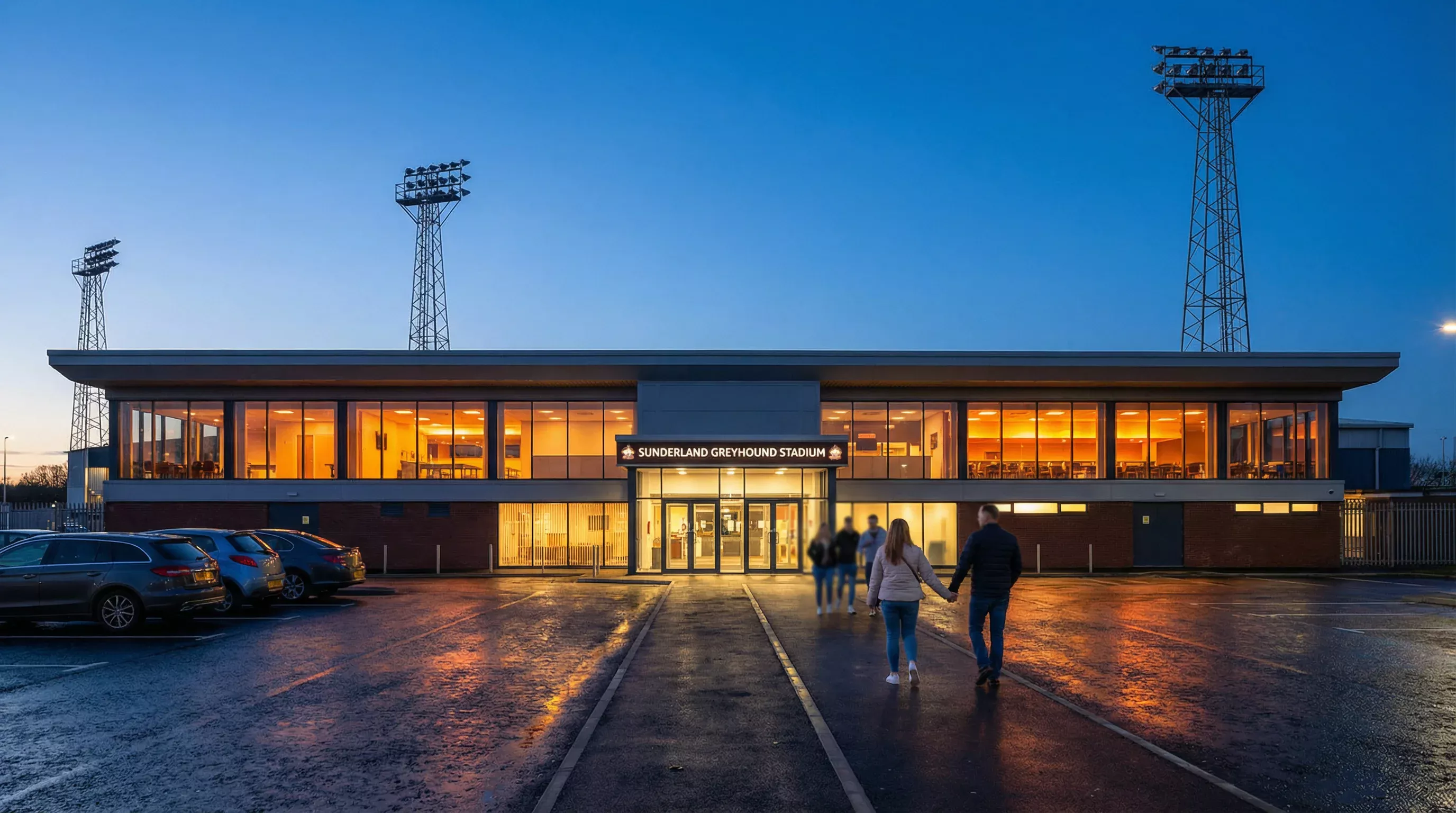
Introduction
Sunderland Greyhound Stadium is not a place that looks impressive in photographs. From the outside it is a functional, no-nonsense venue on the south bank of the Wear, built for purpose rather than spectacle. That is part of its appeal. What the stadium delivers is not architectural beauty but a particular kind of evening — fast, sociable, affordable and over before midnight — that has been drawing people from across the north-east for the better part of a century.
The stadium’s history backs up that longevity. Acquired by Arena Racing Company from William Hill in May 2017, alongside the sister track at Newcastle, Sunderland earned the title of Northern Greyhound Track of the Year from the BGRB in 2005. That award recognised what regulars already knew: the racing is competitive, the surface is well-maintained and the facilities — while not luxurious — are honest and practical.
This guide covers everything before you walk through the gate: how to get there, what you will pay, where to eat, what the evening actually looks like from arrival to last race and what to expect if you have specific accessibility needs. None of this information is complicated, but knowing it in advance makes the difference between a smooth evening and one spent hunting for a car park or queuing at the wrong counter.
Getting There — Road, Public Transport and Taxi
The stadium sits on the southern side of Sunderland, and the track itself — approximately 378 metres in circumference — is enclosed within a site that is well-connected by road but less conveniently served by public transport. How you get there depends on where you are coming from and how much you intend to drink.
By car. From the A19, the stadium is accessible via the A1231 (Wessington Way) heading east into Sunderland. Signposting to the stadium is not always prominent, so it is worth programming the postcode into your sat-nav rather than following road signs. The journey from Newcastle takes around twenty-five minutes outside peak traffic; from Durham, roughly thirty. Parking is available on-site with a dedicated car park adjacent to the stadium. Spaces are usually sufficient for daytime meetings but can fill quickly on busy Friday nights, particularly during Grand Prix or Classic finals. Arriving thirty to forty minutes before the first race is a good rule of thumb to guarantee a space close to the entrance.
By public transport. The nearest Metro station varies depending on the route, but Sunderland city centre is the practical hub. From the Metro station, a taxi to the stadium takes around ten minutes and costs a modest fare. Bus services run through the area but timetables do not always align neatly with race times, especially for evening meetings that finish after 21:30. If you are relying on buses, check return times before you commit — being stranded after the last race is not a theoretical risk.
By taxi. A taxi from Sunderland city centre is the most convenient option for evening visitors who plan to drink. The fare is reasonable and the journey short. For groups of four, splitting a return taxi is usually cheaper per person than the combined bus fare and substantially less stressful. On Friday nights, it is worth booking a return taxi in advance: the stadium empties quickly after the last race and the local taxi ranks can be busy.
One practical point that visitors from outside the area sometimes overlook: Sunderland and Newcastle are close geographically but distinct in their public transport networks. The Tyne and Wear Metro connects the two cities, which makes it feasible to base yourself in Newcastle and travel to Sunderland for the dogs — a common pattern for tourists or stag groups who want access to Newcastle’s nightlife before or after the racing. The total journey from Newcastle city centre to the stadium door, including a short taxi hop from the Metro, takes around forty to fifty minutes and can be managed comfortably before a Friday evening first race.
Whichever route you take, the one thing to plan for is the return journey. The stadium clears out within fifteen to twenty minutes of the last race — there is no lingering post-event atmosphere — and the area around the venue is not overserved by late-night transport. If you are driving, you will be on the road quickly because the car park exits are efficient. If you are relying on a taxi, pre-booking is the difference between waiting five minutes and waiting forty. If you are taking the Metro, check the last service time: Friday and Sunday timetables differ from weekday schedules, and missing the last train turns a cheap evening into an expensive one.
Admission and Hospitality Packages
Sunderland operates a straightforward admission structure. General admission on a standard race night is one of the more affordable entertainment options in the north-east — comfortably below the cost of a cinema trip for two once you factor in the full evening of live sport. Concession rates typically apply for seniors, and children accompanied by adults are often admitted free or at a reduced rate. Exact prices can vary between fixture types — Friday night events may carry a slightly higher admission than daytime BAGS meetings — so checking the stadium’s official website before your visit is worth the thirty seconds.
The stadium runs four fixtures per week — Monday, Wednesday, Friday and Sunday — and the admission pricing can differ slightly across those dates. Daytime BAGS meetings, which primarily serve the off-course betting market, tend to have lower admission (sometimes free entry) because the commercial revenue comes from broadcast and betting rather than gate receipts. Friday night is the premium fixture, aimed at trackside audiences, and the admission reflects that: it is the one night of the week when the gate income meaningfully contributes to the stadium’s revenue.
Beyond general admission, Sunderland offers hospitality packages that bundle entry with a reserved table, a meal and a racecard. These packages are the most popular option for groups — birthdays, corporate outings, hen and stag parties and casual get-togethers all gravitate toward the restaurant and hospitality route. Packages typically include a two- or three-course meal served in the on-site restaurant with a view of the track, a racecard and sometimes a welcome drink. The pricing per head is modest compared to equivalent hospitality at horse-racing venues, which is part of greyhound racing’s appeal as a social outing: you get a full evening of food, drink and live sport for a fraction of what a day at the races would cost at a horse-racing track.
Group bookings benefit from economies of scale. Parties above a certain size may qualify for discounted per-head rates or additional inclusions such as a reserved area near the rail. Corporate events can be arranged with bespoke packages that include branding, exclusive tote access and dedicated hosts. The stadium’s events team handles these bookings directly and can accommodate groups ranging from a dozen people to full-capacity hospitality evenings.
One thing that occasionally surprises first-time visitors: admission does not guarantee a seat. General admission gives you access to the stadium, the stands and the trackside viewing areas, but seating is unreserved and first-come-first-served. If you want a guaranteed table — especially on a busy Friday night or during a Grand Prix final — booking a hospitality package in advance is the only reliable route. Arriving early and staking out a spot in the open stands is the alternative, and it works, but it requires the kind of commitment that is easier to summon in June than in January.
Dining Options — Restaurant, Trackside Food and Bar
Eating at the dogs is part of the experience, and Sunderland offers three broad tiers of food depending on your budget and your tolerance for queueing.
The restaurant. This is the sit-down option, located within the main grandstand with a view over the track. The restaurant serves a set menu — typically two or three courses — timed to fit around the race programme. You eat between races, watch through the windows and place your bets without leaving the table. The food is straightforward: expect pub-quality British fare rather than fine dining. Starters tend toward soups and pâtés, mains lean heavily on grilled meats and pies, and desserts are the kind of thing your grandmother would approve of — sticky toffee pudding, cheesecake, that territory. The quality is honest, the portions are generous and the value for money is high when you consider that the meal is bundled with entry and a racecard in the hospitality package.
Booking is essential on Friday nights. The restaurant fills up, particularly during Grand Prix and Classic periods when the stadium draws its largest crowds. Midweek daytime meetings are easier — you can often walk in and find a table — but the restaurant may not operate on every daytime BAGS fixture. Confirming availability with the stadium before your visit avoids disappointment.
Trackside food. For those who prefer to stay on their feet and watch from the rail, trackside food outlets serve the usual greyhound-stadium staples: burgers, chips, hot dogs, pies and the kind of snacks you eat with one hand while holding a racecard in the other. The prices are reasonable — this is not London — and the food is exactly what you would expect from a counter service at a sporting venue. It is fuel, not cuisine, and it does the job. On a cold Friday night in February, a pie and a cup of tea from the trackside counter is one of the quietly satisfying pleasures of British sport.
The bar. The stadium has licensed bars serving draught beer, spirits and soft drinks. Prices are competitive with local pub rates, which is worth noting because many sports venues apply a premium that makes a pint feel like an investment decision. At Sunderland the bar is affordable enough that a round for a group does not require a second mortgage. The bars can get busy during peak times on Friday nights — between the third and fourth races is a common pinch point — so timing your visit to the bar between less popular races is a small tactical advantage.
One detail that matters for group bookings: if you have reserved a restaurant package, your drinks are usually ordered and paid for separately unless you have arranged an all-inclusive deal. Check the package details when booking. Some hospitality packages include a welcome drink and a bottle of wine for the table; others include entry and food only. The difference can significantly affect the final cost of the evening, and it is better to know in advance than to discover it when the bill arrives.
A note on timing. The restaurant operates around the race schedule, which means service is designed to fit between races rather than flow at the pace of a normal dinner. Starters arrive early, mains are served after the second or third race, and desserts fill a later gap. This pace feels natural once you settle into it, but visitors used to eating at their own speed sometimes find the structure unusual at first. By the main course you will barely notice it — the racing becomes the rhythm and the food fits around it.
The Night Experience — Flow of the Evening, Tipping and Etiquette
A Friday night at Sunderland follows a rhythm that becomes familiar quickly. Gates open roughly an hour before the first race, giving you time to arrive, find your spot — whether that is a restaurant table, a standing position at the rail or a seat in the covered stands — and study the racecard. The first race goes off between 18:00 and 18:30 depending on the scheduling, and from that point a new race starts approximately every twelve to fifteen minutes. A ten-race card takes around two and a half hours, finishing between 21:00 and 21:30. Twelve-race cards push closer to 22:00.
Between races, the stadium operates in a comfortable cycle. Dogs for the next race are paraded in the paddock area, giving you a chance to see their physical condition — weight, muscle tone, demeanour — before they are loaded into the traps. The tote windows stay open until just before each race, and trackside bookmakers (when present) offer fixed odds that sometimes differ from the tote. The brief interval between parade and trap-loading is when the serious punters do their final assessment: watching how a dog moves, how alert it appears and whether it looks settled or agitated in the parade.
Tipping at greyhound stadiums is not a formal expectation, but it does happen. If a tote assistant brings your winnings to your table in the restaurant, a small tip is customary. Trackside, there is no tipping culture — you collect your own winnings from the window and nobody expects a share. This is different from horse racing, where tipping stable staff or valets has a longer tradition. At the dogs, the etiquette is relaxed.
The atmosphere itself is one of the reasons the sport has been growing. Arena Racing Company reported that footfall across its greyhound venues increased in 2025, with Newcastle seeing an 85% rise on finals nights and Dunstall Park recording a 324% increase for the PGR Oaks finals compared to the previous year’s host venue. Sarah from ARC’s Communications team captured the philosophy driving that growth: “Value for money and a quality race night experience are essential not only to attract people trackside, but to encourage them to visit again.” At Sunderland, that value proposition is straightforward — you get a full evening of live sport, decent food if you book it, affordable drinks and the specific thrill of watching six greyhounds tear around a floodlit track for less than you would spend on a meal for two in the city centre.
The crowd on a Friday night is mixed. Regulars who come every week sit alongside first-timers who have booked a group package for a birthday. Stag and hen parties bring noise and enthusiasm without the aggressive edge that can creep into football or boxing events. Families are present too — the dogs are a genuinely all-ages evening out. The shared experience of watching a race, cheering a selection and collecting (or not collecting) a return is a social leveller in a way that more expensive sports events rarely manage.
A few points of etiquette that are not written down anywhere but matter if you want to fit in rather than stand out. Do not stand directly in front of someone who has been at the rail since gates opened — move to the side or find a gap. If you are in the restaurant, keep your cheering proportionate; the tables near the window are close to each other and sustained screaming wears thin by race six. The tote staff are helpful and patient with first-timers, so there is no need to pretend you know what you are doing if you do not — asking for guidance on how to place a forecast bet is not embarrassing and it saves you staking on the wrong thing.
The evening builds momentum naturally. The first two or three races are often lower-grade affairs that serve as warm-ups for the crowd and the track. By the middle of the card the atmosphere has settled into its rhythm, and the higher-quality races tend to cluster between race five and race nine. The last race on the card is usually a shorter-distance event — a deliberate programming choice that sends the crowd home on a burst of speed rather than a long stayers’ grind. If you are planning to leave before the last race to beat the exit traffic, think twice: the final race is often one of the most entertaining on the card.
Accessibility and Facilities
Sunderland Greyhound Stadium is a flat-access venue, which means the majority of the trackside and grandstand areas are accessible without steps. Wheelchair users can reach the main viewing areas, the restaurant and the tote windows without encountering significant barriers. Designated accessible parking spaces are available close to the main entrance, and the distance from car park to trackside is short enough to manage comfortably.
The stadium has accessible toilet facilities within the main building. If you have specific requirements — a carer needing free admission, for example, or a need for a particular seating position in the restaurant — contacting the stadium in advance is the best approach. The events team can arrange adjustments that are difficult to improvise on the night.
For visitors with visual impairments, the live commentary system is an important feature. Every race is called live by a commentator whose audio is broadcast through the stadium’s speaker system, providing a running description of the race that allows you to follow the action even if you cannot see the far side of the track clearly. The commentary is factual and fast — position calls at each bend, distance margins, trap colours — and it is one of those elements of the greyhound-racing experience that is easy to take for granted until you realise how essential it is.
Hearing loop systems may be available in certain areas, though this is worth confirming directly with the stadium if you require one. General noise levels on Friday nights can be significant — crowd buzz, commentary, the mechanical sound of the traps opening — which is worth considering if you have sensory sensitivities.
Other practical facilities include clean and regularly maintained toilets, a cloakroom or secure area for coats and bags (useful on wet evenings when standing trackside), and cash and card payment options at both the tote windows and the food and drink counters. The stadium has moved toward card payments in recent years, but carrying some cash remains useful for tote betting, which in some cases still operates more smoothly with notes and coins.
Sunderland Greyhound Stadium — More on this topic at sunderland dogs results.
See also Sunderland Dogs Live Stream and Replays.
