Sunderland vs Newcastle Greyhounds: Track Differences, Distances and Rivalry
Best Greyhound Betting Sites – Bet on Greyhounds in 2026
 Available in US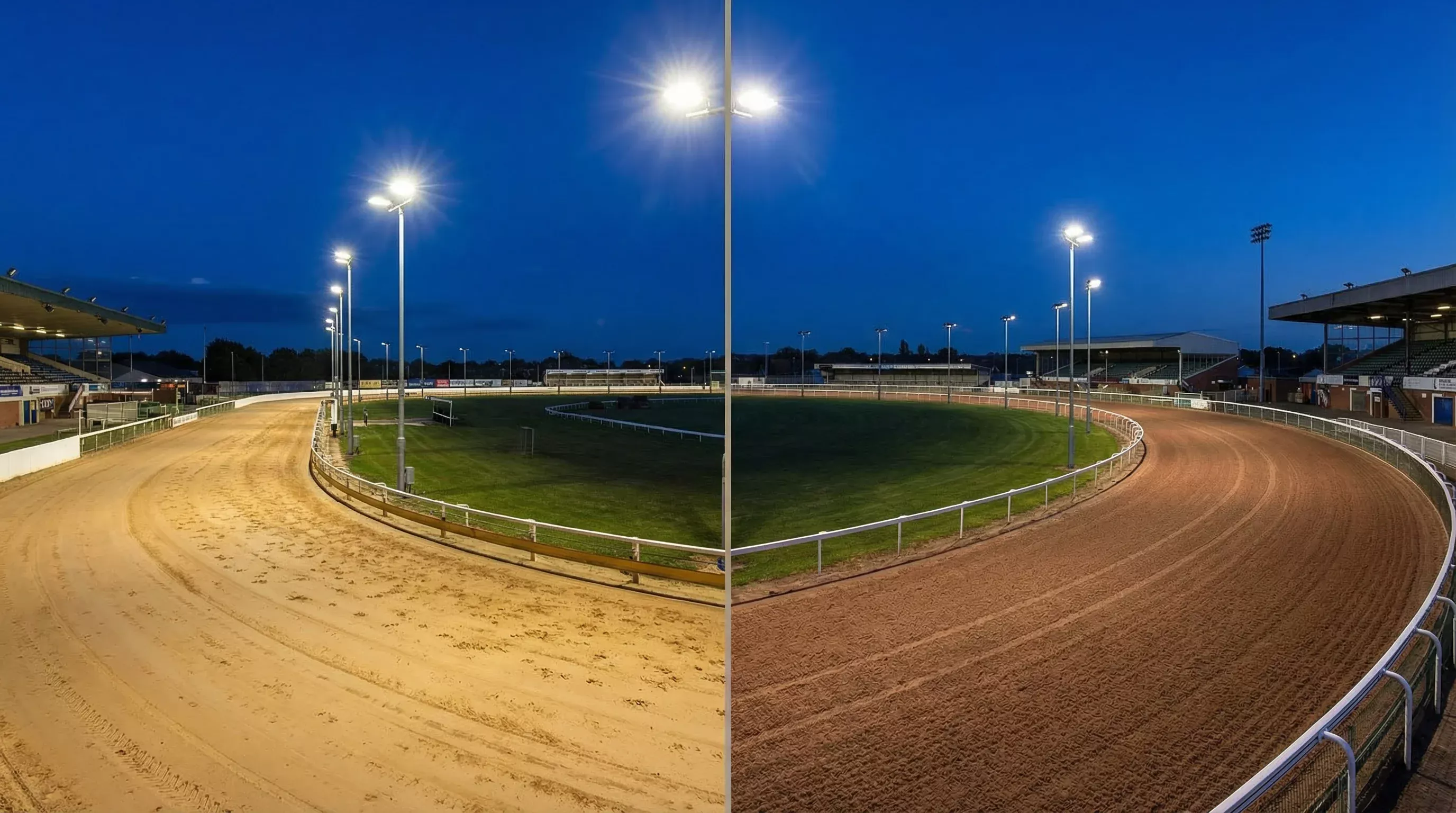
The North East’s Two-Track Rivalry
The north-east of England has two GBGB-licensed greyhound stadiums, and they sit barely twelve miles apart. Sunderland Greyhound Stadium and Newcastle Greyhound Stadium are both owned by the Arena Racing Company, both run under the Premier Greyhound Racing banner, and both draw from the same regional pool of trainers and owners. On paper, they are siblings. In practice, they are rivals — two venues with different characters, different track specifications, and different audiences, competing for the same Friday-night crowd and the same loyalties in a region where sporting identity runs deep.
The Sunderland–Newcastle dynamic mirrors the broader sporting rivalry between the two cities. It is rarely hostile but always present, expressed in preferences, comparisons, and the quiet conviction on each side that their track is the better one. For bettors and form analysts, the rivalry is less emotional and more practical: the two tracks produce different racing, and understanding those differences matters when dogs transfer between venues or when you are comparing form lines across the region.
Spec Comparison: Circumference, Distances, Surface and Hare
The physical specifications of the two tracks are similar in broad terms but differ in details that affect the racing. Sunderland’s circumference measures 378 to 379 metres. Newcastle’s circuit is slightly different in dimension, producing bends of a marginally different radius and straights of a different length. Both tracks use all-weather sand surfaces, but the specific composition and maintenance regimes create subtle differences in speed and grip that show up in the finishing times.
Sunderland races over four distances: 261m, 450m, 640m, and 828m. Newcastle offers a partially overlapping but not identical set of distances, meaning certain trips are available at one venue but not the other. A dog that has been campaigned at a distance unique to Newcastle will have form that does not translate directly to Sunderland, and vice versa. When dogs move between the two tracks — which happens regularly, given the shared training community — the distance mismatch can produce deceptive results in the first few runs at the new venue.
Both stadiums were acquired by ARC from William Hill for £9.4 million in May 2017, a single transaction that brought the region’s two greyhound venues under one corporate umbrella. That shared ownership means the two tracks are co-ordinated in their scheduling — they do not race against each other on the same nights — and their fixture lists are designed to complement rather than cannibalise each other. A trainer with dogs at both venues can campaign across the region without fixture clashes, which is a practical benefit of the ARC model.
The hare system is another point of comparison. Sunderland uses an Outside McGee — a rail-mounted lure running on the outside of the track. Newcastle’s hare configuration may differ, and the lure position affects the running line that dogs take through the bends. A dog accustomed to chasing an outside hare at Sunderland may behave differently at a venue with an inside-running lure, which is a variable that experienced trainers account for when moving dogs between tracks.
Grading Pool Differences: Separate Pools, Shared Trainers
Despite the proximity and shared ownership, Sunderland and Newcastle operate separate grading pools. Each track maintains its own grade structure, assigns grades based on performances at that specific venue, and constructs race cards from its own pool of registered runners. A dog graded A3 at Sunderland is not automatically A3 at Newcastle — it will be reassessed based on its form and given a grade that reflects the competitive standard at the other venue.
The separation makes sense because the tracks are different enough that a dog’s grade at one may not accurately represent its ability at the other. A dog that excels on Sunderland’s slightly wider bends might struggle at Newcastle if the tighter geometry there does not suit its running style. Conversely, a dog that thrives at Newcastle might find Sunderland’s layout more forgiving and perform above its Newcastle grade.
The trainers, however, are shared. Many of the handlers who race dogs at Sunderland also race at Newcastle, and their kennels contain runners registered at both venues. This creates an information asymmetry that favours the training community: a trainer knows whether a dog has been performing well in trials on Sunderland’s sand before entering it at the venue, while the public form card may only show its Newcastle results. For bettors, tracking which trainers operate at both tracks — and noting when they move dogs between them — is one of the more reliable ways to spot value in the form.
The shared trainer pool also means that grading decisions at one track can be influenced by events at the other. A dog that has been dominant in D-grade racing at Newcastle might be entered at Sunderland at a higher initial grade, because the racing manager knows the dog’s true ability exceeds its Newcastle classification. These cross-venue assessments are part of the grading manager’s discretion and are not always visible in the published data.
For the form analyst, the practical implication is clear: when a dog appears at Sunderland with form figures from Newcastle, do not accept the raw positions and times at face value. Convert the form through a calculated-time adjustment that accounts for the differences between the two tracks. A dog that finished third in a B2 at Newcastle is not necessarily a third-place B2 dog at Sunderland. The grade may translate differently, the times will translate differently, and the dog’s running style may interact with Sunderland’s geometry in ways that the Newcastle results cannot predict.
Regional Context: Fanbases, Event Nights and Local Identity
The rivalry between Sunderland and Newcastle greyhound stadiums exists within a broader regional context that gives it meaning beyond the racing itself. The Wear–Tyne divide is real in sport — Sunderland AFC versus Newcastle United is the defining fixture — and greyhound racing inherits some of that tribal loyalty. Sunderland regulars tend to think of their track as the better venue. Newcastle regulars disagree. Neither side is entirely wrong.
The two tracks serve partially overlapping but distinct catchments. Sunderland draws primarily from Wearside, County Durham, and the southern parts of Tyne and Wear. Newcastle draws from Tyneside, Northumberland, and the northern fringe. The overlap occurs in the middle — residents of Gateshead, Washington, or Chester-le-Street can reach either venue within twenty to thirty minutes, and their choice often comes down to habit, fixture timing, or the quality of the evening’s entertainment.
Event nights are where the competitive tension is most visible. Both stadiums host Category One competitions and promote their Friday evening fixtures as social occasions. Newcastle has seen impressive attendance growth — ARC reported an 85% increase in footfall at Newcastle’s final nights in 2025 — which puts pressure on Sunderland to match that energy with its own flagship events. The Grand Prix and Classic at Sunderland are the calendar highlights that anchor the stadium’s competitive offer, and their success determines whether Sunderland holds its position as the region’s premier greyhound venue or cedes ground to its northern neighbour.
The local identity of each track is also shaped by its history and its community of handlers. As Jimmy Fenwick, a respected local handler, reflected when speaking about the late Harry Williams — one of the north-east greyhound scene’s most revered figures — the community around these tracks is one that extends its respect well beyond the region’s borders. That sense of belonging, of being part of something with roots and continuity, is what gives the Sunderland–Newcastle rivalry its texture. It is not about which track has the wider bends. It is about which track feels like home.
Sunderland vs Newcastle Greyhounds — More on this topic at sunderland dogs results.
See also History of Sunderland Greyhound Stadium.
