Sunderland 640m Results: Stayers Distance Times, Bends and Pace Analysis
Best Greyhound Betting Sites – Bet on Greyhounds in 2026
 Available in US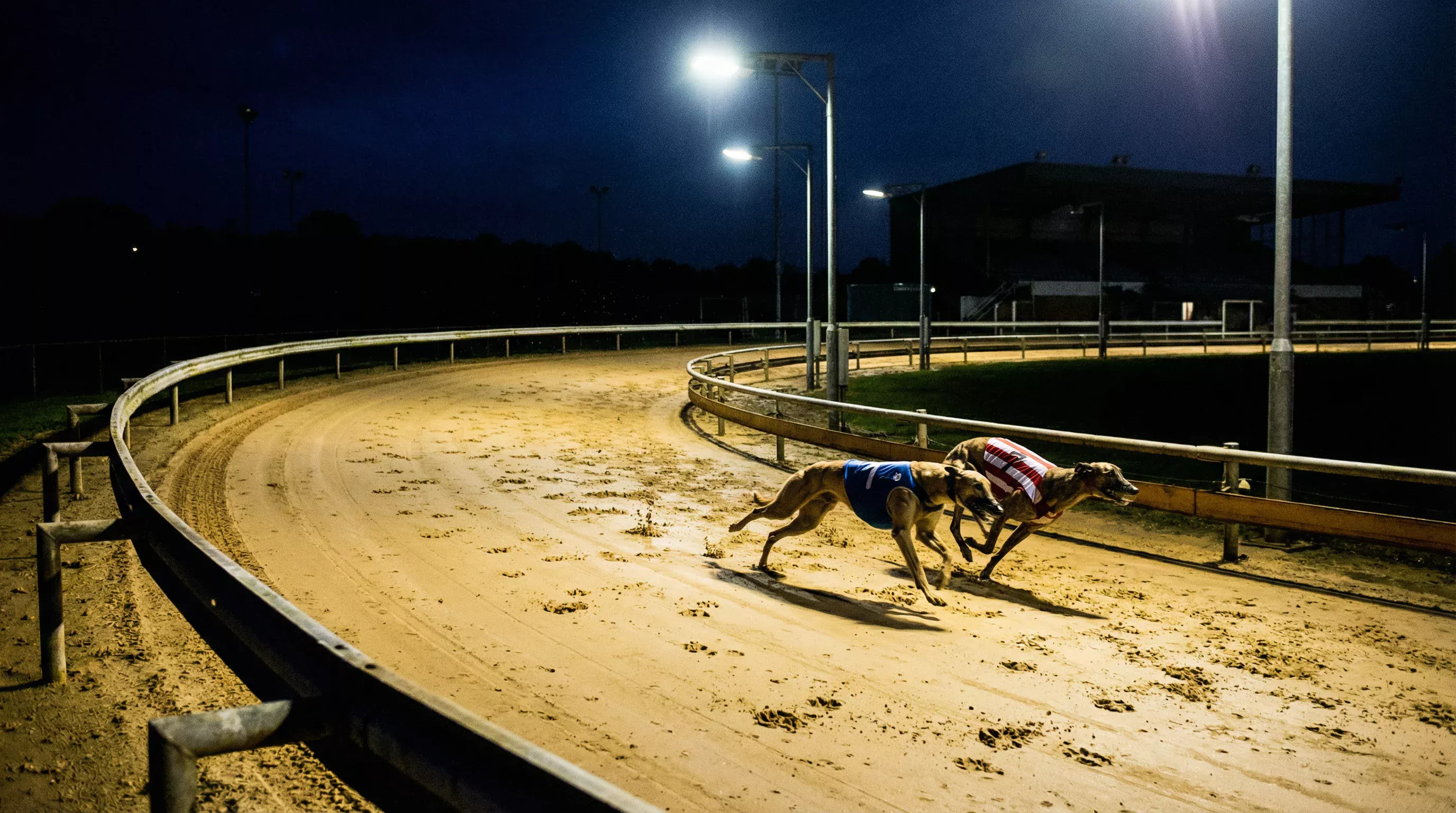
The Stamina Test on Sunderland’s Sand
The 640m at Sunderland is where the conversation changes. At the standard 450m trip, early pace and trap speed dominate discussion. Add another 190 metres and the balance shifts. Stamina stops being a nice-to-have and becomes the deciding factor, separating dogs that can sustain effort over four bends from those that cannot.
Stayers races are less common on the card than the 450m, which makes their results both more valuable and harder to analyse with the same depth. A dog might race the standard distance three times for every once it runs at 640m, so the sample sizes are smaller and the form figures carry more weight per run. That scarcity also means the 640m attracts a more specialised type of runner — dogs bred or trained for distance work, often with different physical profiles and running styles from those you see contesting the sprints.
Understanding the 640m at Sunderland means understanding bend positions, the effect of the all-weather sand on tired legs, and the tactical patterns that repeat across stayers fields. The data is there in the results. The trick is knowing what to look for.
Stayers Profile: What Kind of Dog Excels at 640m
Not every greyhound is built for 640 metres, and not every dog with the lungs for it has the racing brain to use them properly. The typical stayer at Sunderland combines two qualities: an aerobic capacity that allows sustained speed and a willingness to settle into a rhythm rather than spend everything in the first hundred metres. Dogs that burn brightest early rarely translate their 450m form to the longer trip. The extra distance punishes wastefulness.
Physically, successful 640m runners tend to be slightly rangier than their sprint counterparts, though the difference is less dramatic than outsiders might expect. What matters more is the dog’s stride pattern under fatigue. A stayer that shortens its stride smoothly will decelerate less than one whose gait becomes choppy. Trainers watch for this in trials, and it often determines whether a dog is campaigned at 450m or stepped up.
Running style matters as much as physiology. The best 640m dogs at Sunderland are typically mid-pack runners through the first two bends who move into contention on the back straight and assert themselves from the third turn onward. Front-runners can win at 640m, but they need a clear lead and efficient cornering to absorb the inevitable late challenge. The dog that leads by two lengths at the second bend but is caught at the last is a recurring figure in stayers results — a reminder that early position is less valuable when there is more track left to run.
Pedigree plays a role too. Sire lines known for stamina tend to produce offspring that handle the 640m better, particularly those with Irish bloodlines bred for middle-distance coursing. A dog’s breeding is not a guarantee of distance aptitude, but when you see an unraced or lightly-raced greyhound from a stayers sire line entered at 640m, the kennel is making a deliberate choice based on lineage as much as trial performance.
Bend Positions at 640m: How Corners Reshape the Race
The 640m race at Sunderland involves four bends — two more than the standard trip — and each one acts as a sorting mechanism. The first bend arrives after a run-up of roughly 84 metres, shorter than the 93 metres dogs get at 450m. That reduced run-up compresses the early speed phase and makes the first bend tighter in terms of the field’s grouping. Dogs have less time to separate before the turn, which means the first bend at 640m produces more crowding and more tactical jockeying than the same bend at the standard distance.
Positions at each bend are recorded and published in the race result. A dog listed as first at bend one, second at bend two, and first at bend three is showing a specific racing pattern — early prominence, a brief challenge, then reassertion. Reading these positional sequences across multiple 640m results is one of the most reliable ways to identify a dog’s running style. A consistent third-at-bend-one, first-at-bend-four pattern is the hallmark of a classic closer. A consistent first-at-every-bend pattern belongs to a front-runner — and at 640m, the question is whether that front-runner can hold through the final turn.
The third bend is where 640m races are most often decided. By this point, the field has been running for around 450 metres, which is the equivalent of a full standard race. Dogs with limited stamina begin to shorten their stride here. Those with reserves make their move. If you are analysing a 640m result and want to identify the most significant moment, look at the positional change between the second and third bends. Any dog that moves up here is doing so against the grain of fatigue, and that is a stronger indicator of true ability than moving up between the first and second bends, when most dogs are still fresh.
The fourth bend, the final turn, is where races are lost rather than won. A tired dog that drifts wide on this bend gives up lengths it cannot recover in the short run to the line. A dog that holds the rail through the last turn — even if it is not the fastest in the field — often finishes higher than its raw speed would suggest, simply because others are losing ground on the corner. At 640m, cornering efficiency under fatigue is worth as much as pace.
The Stamina Factor: Sand Surface and Late-Race Deceleration
Sunderland’s all-weather sand surface is a constant in every race at the stadium, but its influence becomes most visible at 640m. Sand demands more muscular effort per stride than a harder surface. Over a 450m race, the additional energy cost is manageable for most dogs. Over 640m, it accumulates. By the time a field reaches the third bend, the surface has been taxing the dogs’ hindquarters for nearly thirty seconds of sustained effort, and the difference between a fit dog and a slightly underprepared one becomes unmistakable in the sectional times.
The deceleration curve at 640m on sand is steeper than the equivalent on a firmer track. This has two practical consequences. First, times at Sunderland’s 640m tend to be fractionally slower than at venues with different surfaces, so raw comparison across tracks is misleading. Second, dogs that have trained consistently on sand — particularly those based at Sunderland — hold an advantage over newcomers. A greyhound arriving from a track with a different surface may need two or three runs to adjust its stride pattern. Those adjustment runs often produce deceptively poor results that do not reflect the dog’s true ability at 640m.
Weather affects the sand’s behaviour too. After heavy rain, the surface absorbs moisture and becomes slightly heavier, amplifying the stamina demand. In dry conditions, the going is faster and the deceleration less pronounced. Sunderland publishes going reports before each meeting, and at 640m, this information matters more than at any other distance. A stayer that thrives on firm sand may struggle when the surface is damp, not because of any loss of ability but because the conditions shift the balance further toward stamina, and even stamina specialists have limits.
For bettors, the stamina factor at 640m creates a useful filter. Look at a dog’s last two or three runs at this distance and note its finishing splits. A dog whose final section is deteriorating across runs may be carrying an underlying fitness issue that the overall time does not yet reveal. Conversely, a dog whose closing splits are stable or improving — even if it has not won recently — is a candidate to improve its finishing position in the near future. The sand, unforgiving as it is, does not lie. It simply makes the truth visible a bend or two later.
Sunderland 640m Results — More on this topic at sunderland dogs results.
See also Sunderland 261m Sprint Results.
