Sunderland 261m Sprint Results: Trap-to-Line Data for the Shortest Distance
Best Greyhound Betting Sites – Bet on Greyhounds in 2026
 Available in US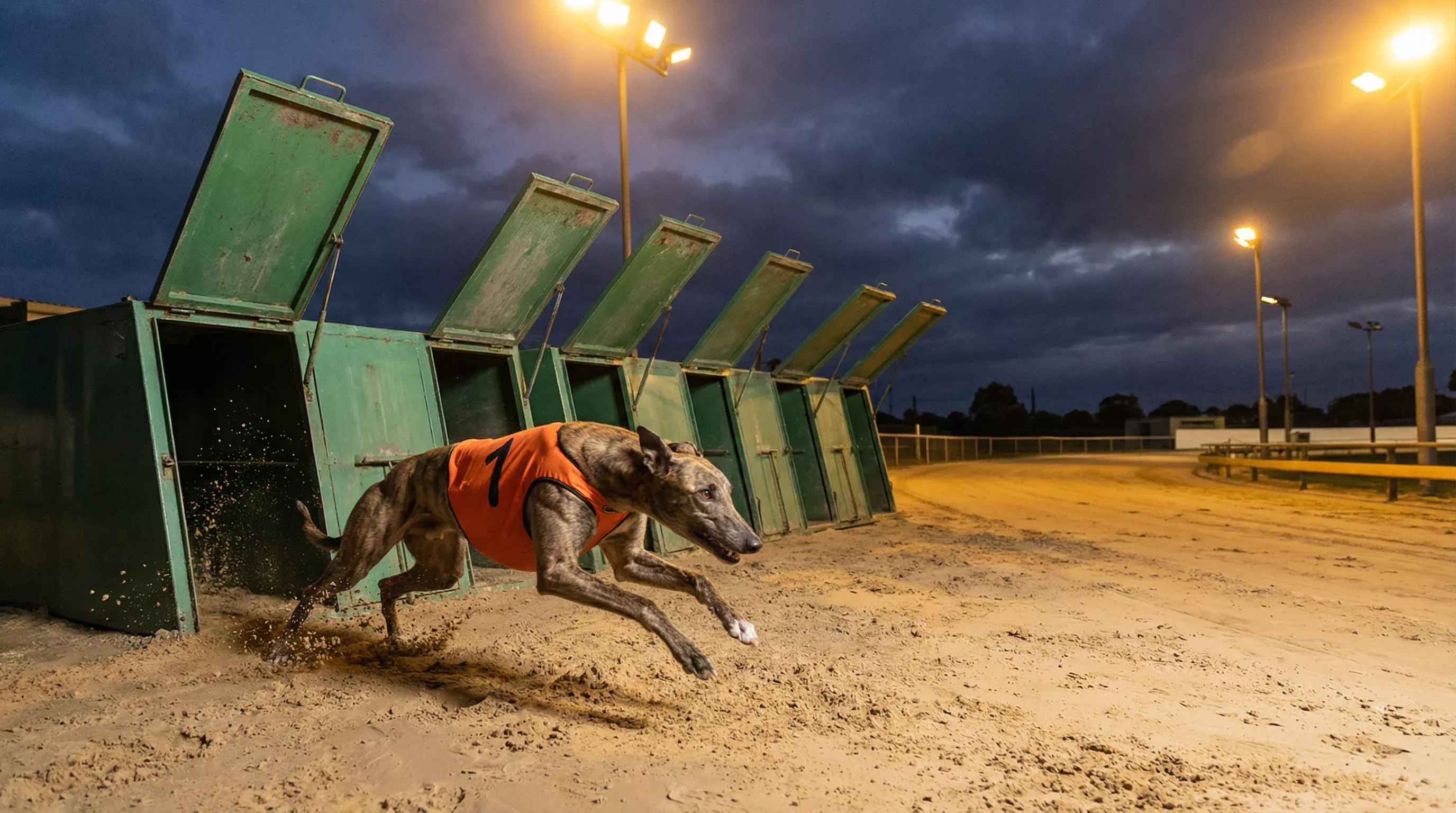
Fifteen Seconds of Raw Speed
The 261m sprint at Sunderland is the shortest distance on the card and the most unforgiving. There is one bend, one chance, and roughly fifteen seconds between the traps opening and the first dog crossing the line. Everything that matters happens immediately. Hesitate at the boxes and the race is over before you have reached the turn.
Sprint races occupy a specific niche in greyhound racing. They appear less frequently on the card than the 450m and attract a distinct category of runner — dogs whose speed out of the boxes is their greatest asset. The margin for error is effectively zero. At 450m, a dog can recover from a poor start by gaining ground over two bends. At 261m, recovery is a fantasy. Whatever position a dog holds at the first bend is, more often than not, the order in which the field will finish.
That simplicity is deceptive. Beneath the surface, 261m results contain patterns — patterns in trap draw, in early pace, in the physical traits that produce consistent sprint performance. Reading those patterns properly turns the shortest race at Sunderland into something more than a coin toss.
Sprint Mechanics: Why the First Bend Decides 261m Races
At Sunderland, the 261m trip involves a straight run from the boxes, a single left-hand bend, and then the home straight to the finish. The track’s circumference of 378 to 379 metres and its Outside McGee hare system mean the 261m distance covers slightly more than two-thirds of the full circuit, and all of the drama is compressed into the first half.
The opening phase — the run from the traps to the bend — is where sprints are decided. Dogs accelerate from a standing start to top speed in approximately three to four seconds, covering the straight in a burst that separates the field by as much as two or three lengths before they even reach the turn. That separation at the bend becomes almost permanent. The dog on the inside rail at the turn has the shortest path. A dog on the outside, even if equally fast, covers more ground around the curve and loses time that cannot be recovered in the brief run-in.
This is why trapping speed matters more at 261m than at any other Sunderland distance. A dog that breaks half a length behind at 450m has several hundred metres and multiple bends to find a way past. A dog that breaks half a length behind at 261m has one bend and a short straight, and the geometry of the turn works against any overtaking attempt. The inside rail tightens; the outside opens up. Passing on the inside requires the leading dog to drift. Passing on the outside requires covering extra distance that is not available.
The mechanics of the single bend also explain why crowding at the first turn is the primary cause of interference in sprint results. With six dogs converging onto a tight curve after a short straight, bumping and checking are common. A dog that gets checked at the bend in a 261m race is not just losing a length — it is losing the race. The race comment will note “checked first bend” and the finishing position will reflect a dog running well below its ability. When you see that comment in a sprint result, treat the performance as voided rather than as evidence of declining form.
Trap-to-Line: How Starting Position Translates to Finish at 261m
Trap draw matters at every greyhound distance, but at 261m it is amplified to the point where it becomes arguably the single most important variable. Across UK tracks, Trap 1 typically wins at a rate of 18 to 19 per cent — above the 16.6 per cent that a perfectly equal distribution would produce. The inner trap benefits from the protected rail position, and the effect is most pronounced at sprint distances where the first bend arrives quickly and inside running saves the most ground.
At Sunderland, the trap bias picture is more balanced than at most tracks, with each trap winning at roughly 17 per cent over a large sample. That near-parity holds across the card as a whole. But at 261m specifically, the dynamics tilt toward inside traps more sharply than the overall figure suggests. The reason is geometry: with only one bend and a short straight, the distance saved by running on the rail is a higher proportion of the total trip. At 450m, saving half a length on one bend is offset by two more bends where anything can happen. At 261m, there is nowhere else for the race to go.
This does not mean Trap 1 always wins sprints, of course. A slow-breaking dog drawn inside will be swallowed up by a faster starter from Trap 3 or 4. And a dog that traps cleanly from Trap 6 on the wide outside can still win if it has enough raw pace to reach the bend first and cut across to the rail. But when two equally matched dogs meet at 261m — one drawn in Trap 1, the other in Trap 6 — the inside runner holds a measurable edge before a stride has been taken.
For practical form study, track the trap draw of every 261m runner across its recent results. If a dog has been producing mediocre sprint finishes from wide draws and is now moved inside, the improvement is often immediate. Similarly, a dog with a strong 261m record from Trap 1 that suddenly finds itself in Trap 5 may underperform — not through any decline in ability, but because the geometry has shifted against it. At this distance, the numbers between trap and finishing position are more tightly correlated than at any other trip on the card.
Sprint Specialists: Traits That Define a 261m Winner
The greyhound that excels at 261m is a different animal from the one that wins at 640m, sometimes literally. Sprint specialists tend to be compact, muscular, and explosively quick out of the traps. Their defining trait is reaction time — the gap between the lids lifting and the dog being at full speed. At longer distances, a fraction of a second at the start is absorbed by the race. At 261m, it is the race.
Trainers who campaign sprint specialists often speak about a dog’s “box manners,” meaning its behaviour inside the starting trap in the seconds before the lids open. A dog that is calm, focused, and ready to drive forward the instant the trap opens will beat a more naturally fast dog that is distracted or turning its head. Box manners are trained and refined, and they are one reason that experienced sprint dogs tend to outperform younger ones over this distance. Speed can be inherited, but trapping is learned.
Weight is another factor that shows up in 261m data more clearly than at standard distances. Sprint greyhounds tend to race at the lighter end of the scale for their frame, because carrying extra weight penalises acceleration disproportionately. A weight increase of half a kilogram might be negligible at 450m but measurable at 261m, where the race is decided in the first few strides. Sunderland publishes race-day weights, and tracking a sprint dog’s weight across runs can reveal patterns — a dog that has gained weight since its last sprint outing may trap a fraction slower, and at this distance, fractions are everything.
The best sprint results at Sunderland come from dogs that combine three elements: fast trapping, an inside or mid-inside draw, and consistent weight. When all three align, the outcome is close to predictable. When one is missing — a slow trap, a wide draw, or a weight fluctuation — the dog becomes vulnerable regardless of its underlying speed. That is both the challenge and the appeal of the 261m for anyone studying the results: the variables are few, but each one carries enormous weight.
Sunderland 261m Sprint Results — More on this topic at sunderland dogs results.
See also Sunderland 828m Marathon Results.
