Friday Night at Sunderland Dogs: A First-Timer's Guide to Race Night
Best Greyhound Betting Sites – Bet on Greyhounds in 2026
 Available in US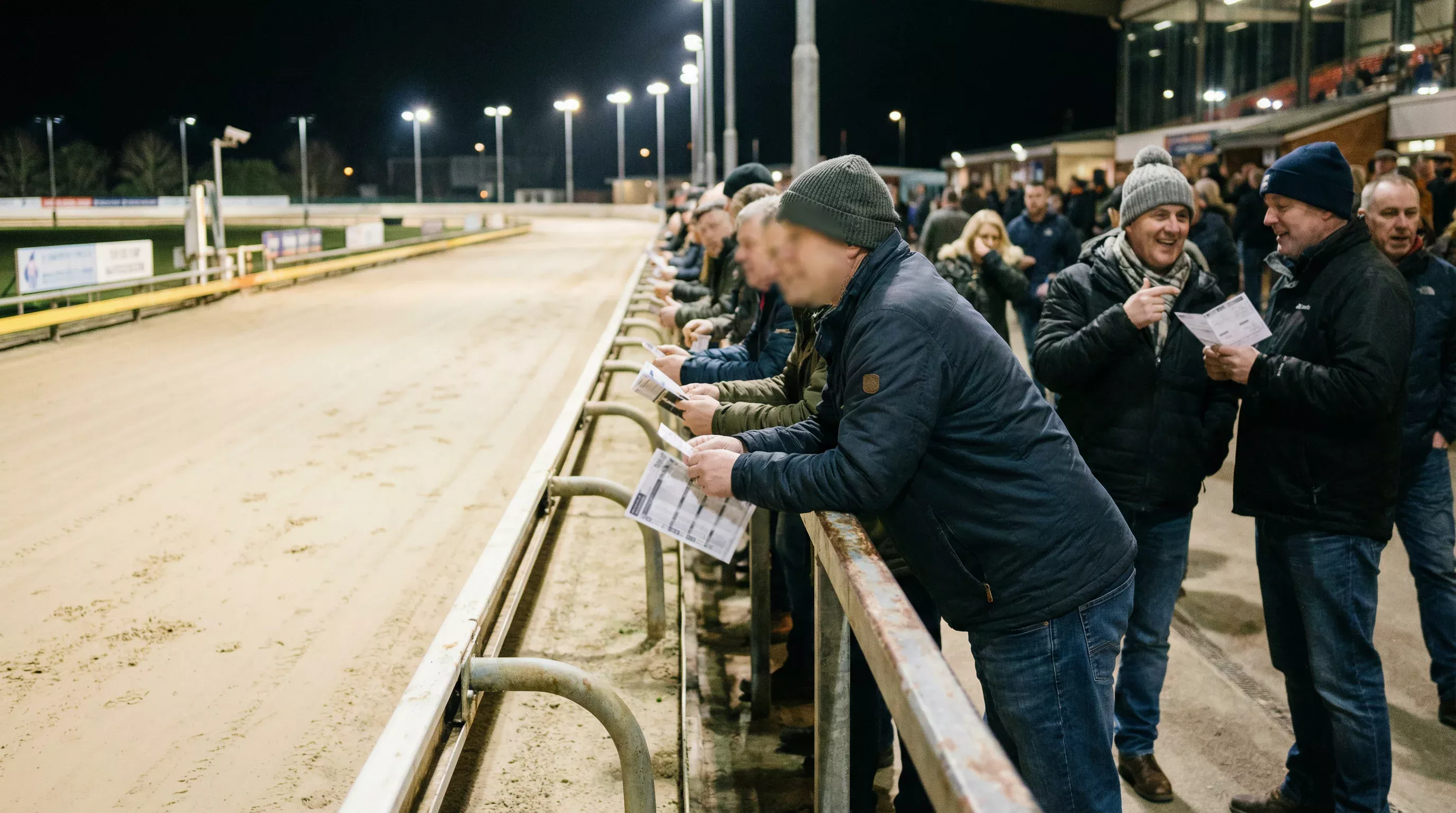
Your First Friday Under the Floodlights
There are four race meetings a week at Sunderland Greyhound Stadium, but only one that qualifies as an event. Friday night is when the stadium wakes up. The floodlights come on, the restaurant fills, the stands accumulate a crowd that is louder and larger than anything the daytime meetings produce, and the racing takes on an energy that the midweek cards — functional, competent, but essentially for the betting market — simply do not have.
If you have never been to the greyhound racing and you are looking for a starting point, Friday night at Sunderland is the one to try. It is the meeting designed for the general public, not just the form students and the regulars. And like most things that look effortless when done well, there is a structure to the evening that rewards a small amount of advance knowledge.
Evening Rundown: Timeline From Gates Open to Last Race
The Friday evening at Sunderland follows a consistent rhythm. Gates open around an hour before the first race — typically between 5:00 and 5:30 pm — allowing time for the early arrivals to park, collect their racecards, and settle into their preferred position. The racecard is the evening’s programme: it lists every dog in every race, along with their form, trap draw, trainer, and weight. For a first-timer, the racecard is simultaneously essential and baffling; it contains everything you need to make an informed bet, but the abbreviations and codes take time to learn.
The first race goes off at approximately 6:00 to 6:30 pm, and from there the card runs at intervals of roughly twelve to fifteen minutes. Each race lasts about thirty seconds — sometimes less — and the gap between races is filled with the parade of dogs for the next event, the posting of odds, and the general buzz of a crowd discussing form, arguing over selections, and queuing at the tote windows.
The card typically features ten to twelve races, spread across the evening and concluding somewhere between 9:00 and 9:30 pm. The distances vary — you will see the standard 450m, the occasional sprint at 261m, and perhaps a stayers race at 640m — and the grades range from the lower end to the upper, with the quality of the racing generally peaking in the middle of the card when the higher-graded races are scheduled.
Restaurant diners follow a slightly different timeline. Arrival is typically earlier, with seating arranged before the first race and courses served between races throughout the evening. The restaurant experience integrates dining with the racing rather than running parallel to it, and the kitchen’s service schedule is timed to the card rather than to the clock.
First-Timer Tips: What to Wear, How to Bet, What to Eat
Dress code at Sunderland on a Friday night is relaxed. There is no jacket-and-tie requirement, no formal standard to meet. Smart casual is the norm — jeans and a decent top will take you anywhere in the venue without raising an eyebrow. In winter, bring a warm coat for the sections of the evening you spend outside watching trackside; in summer, the outdoor areas are comfortable in lighter clothing. Practical footwear is advisable — the car park and trackside areas are functional rather than manicured.
Betting as a first-timer is simpler than it looks. The tote operates on a pool-betting basis: you place your bet into a pool with everyone else, and the returns are calculated from the total pool divided among the winners. A basic win bet — pick the dog you think will finish first — is the simplest option. Place your stake at the tote window, name the trap number of your selection, and collect if it wins. If you want something more adventurous, forecast bets (picking first and second) and tricast bets (first, second, and third in order) offer higher returns for higher difficulty. Start with win bets. Build from there.
Eating at the stadium depends on your package. If you have booked the restaurant, your meal is included and will be served at your table. If you are on general admission, the stadium has food and drink outlets where you can buy bar meals, snacks, and drinks throughout the evening. The quality is event catering — decent, filling, and priced for a night out rather than a restaurant. A pint and a pie at the trackside bar is a Friday-night tradition for the non-restaurant crowd, and it is a perfectly enjoyable way to fuel the evening.
One tip that first-timers rarely hear: watch the pre-race parade. Before each race, the dogs are walked around a parade ring in front of the stands. This is your chance to see the dogs in the flesh before they enter the traps — their body condition, their temperament, their walk. An experienced eye can spot a dog that looks fit and alert versus one that appears flat or agitated. You will not develop that eye on your first visit, but watching the parade is part of the rhythm of the evening, and it makes the race that follows more engaging because you have seen the dogs up close.
Atmosphere Guide: Crowd Energy and Between-Race Entertainment
The atmosphere on a Friday night at Sunderland is the product of its crowd, and that crowd is a mix: regulars who have been coming for years, couples on a date night, groups celebrating birthdays or office outings, and the occasional first-timer trying to work out why everyone is shouting at a mechanical hare. The energy builds through the evening. The early races attract moderate attention; by the middle of the card, the crowd has settled in, the bar has done its work, and the noise level at the finish line is genuinely exciting.
Between races, the atmosphere is social rather than sporting. People talk, compare racecard notes, debate the merits of trap 3 versus trap 5, and queue for the next round. The gap between races is short enough that the momentum never dies but long enough that you do not feel rushed. It is a rhythm that works — thirty seconds of intense focus followed by twelve minutes of conversation, then thirty seconds of focus again. By the sixth or seventh race, you are locked into the pattern, and the evening has found its groove.
The growth in attendance at ARC’s greyhound venues suggests that more people are discovering this particular combination of sport, social occasion, and low-stakes gambling. As Sarah from ARC Communications noted, delivering value and a quality experience is what brings people back. Newcastle’s final nights drew 85% more spectators in 2025 than the previous year, and the trend applies across the portfolio. Friday night at Sunderland is a product that has been refined over decades, and in 2026 it is performing as well as it ever has.
One final note for the first-timer: do not overthink it. The racing is fast, the evening is structured, and the venue does the heavy lifting. You do not need to be an expert to enjoy it. Pick a dog based on its name if you like — half the restaurant crowd does exactly that, and they have just as good a time as the form students with their annotated racecards. The dogs do not know who backed them. The hare does not care about your selection methodology. Thirty seconds of six greyhounds at full speed, under floodlights, with a crowd around you — that is the product, and it works whether you understand the form or not.
Friday Night at Sunderland Dogs — More on this topic at sunderland dogs results.
See also Greyhound Racing on TV and RPGTV.
