Sunderland Greyhound Form Guide: How to Analyse Recent Runs at This Track
Best Greyhound Betting Sites – Bet on Greyhounds in 2026
 Available in US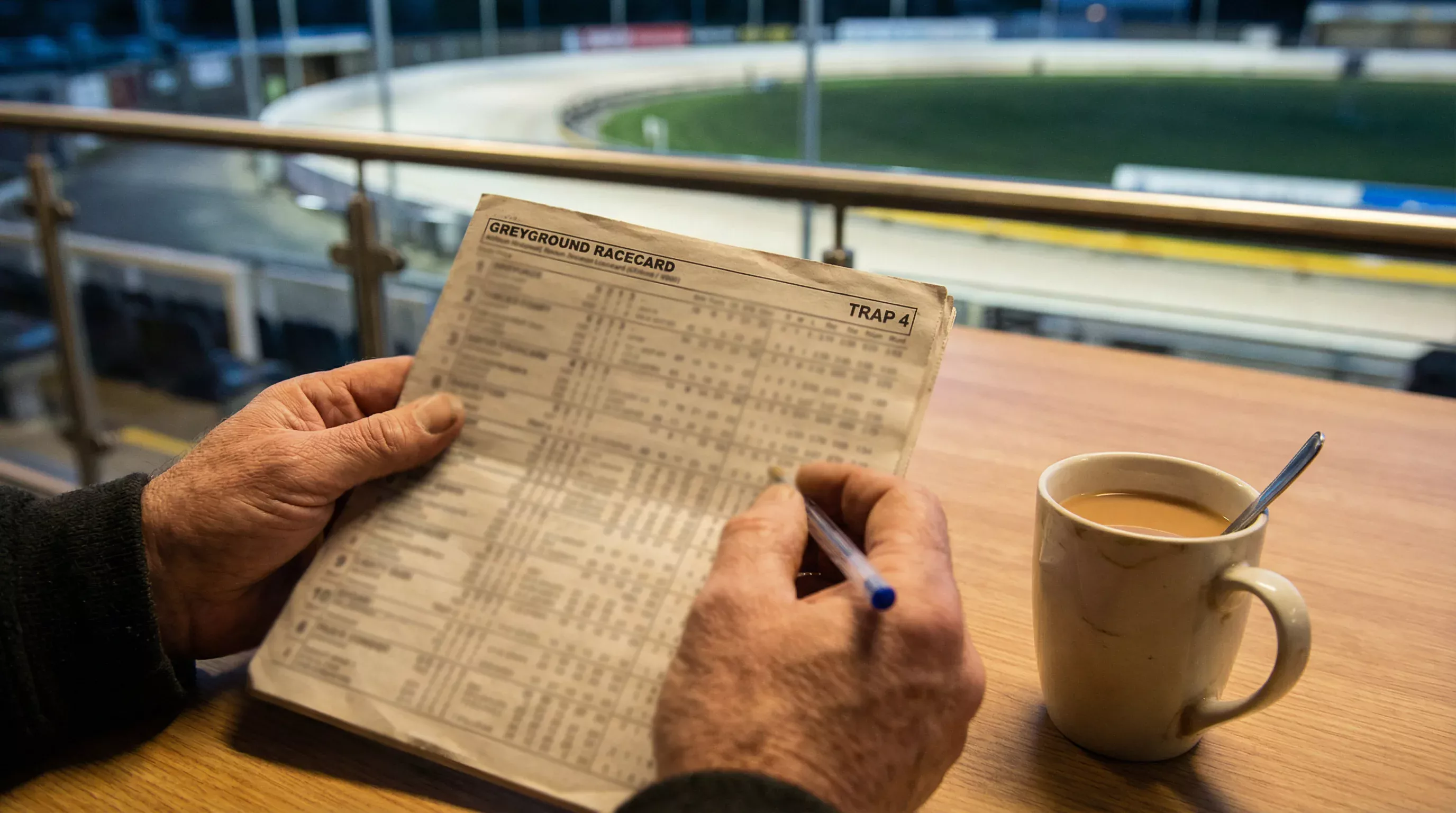
Reading Between the Lines of Sunderland Form
Form is the single most predictive tool available to anyone studying greyhound results. Not trap draws, not trainer names, not the colour of the jacket — form. The record of a dog’s recent performances, distilled into a sequence of numbers, comments, and times, contains more useful information per square centimetre than anything else on the racecard. The challenge is extracting that information accurately.
At Sunderland, form analysis is shaped by the track’s characteristics: its balanced trap distribution, its all-weather sand surface, and its four-fixture weekly schedule that generates a steady stream of data. A dog racing regularly at this venue will build a form profile quickly, and that profile — if you know how to read it — will tell you not just where the dog finished but why it finished there, how it ran, and whether the performance is likely to be repeated.
What follows is a guide to decoding Sunderland form. The aim is to move you from seeing numbers to understanding them.
Last Six Decoded: What Each Position and Comment Tells You
The standard form display for any greyhound shows the results of its last six races, read from left to right with the most recent run on the right. Each entry typically includes the finishing position, the trap drawn, the distance, the grade, the time, and a short race comment. Together, these six lines form a compressed narrative of the dog’s recent career. Learning to read that narrative is the foundation of Sunderland form analysis.
Start with the finishing positions. A sequence of 1-1-2-1-3-1 describes a dog that is winning consistently with the occasional minor setback. A sequence of 4-5-6-3-4-5 describes a dog that is struggling in its current grade. But raw positions are only the surface. A dog that finishes second by a short head in an A2 race is performing at a higher level than one that finishes first by six lengths in a D3. The grade attached to each run is essential context — without it, the position number is almost meaningless.
Race comments add another layer. Abbreviations like “Crd” (crowded), “Bmp” (bumped), “Ckd” (checked), and “Wide” describe incidents during the race that affected the dog’s performance. A dog showing “Ckd 1st” in its last two runs has been impeded at the first bend twice — its finishing position in those races does not reflect its true ability. Conversely, a dog with “Led” or “AlwLed” (always led) in its comments is demonstrating front-running dominance. When you see a run with a poor finishing position but a comment like “Ckd&Fell” or “Bmp 3rd,” treat it as a voided result rather than evidence of decline.
The relationship between form and favouritism is worth noting. Across UK graded races, the favourite wins approximately 35.67% of the time. That figure is shaped almost entirely by form — the market identifies the dog with the best recent record and prices it accordingly. At Sunderland, where trap bias is minimal, form carries even more weight in determining favouritism. The dog at the top of the market is there because its last six runs suggest it should be, and the favourite’s strike rate at this track is broadly in line with the national average. When form and market agree, they are right roughly a third of the time. When they disagree — when a dog with strong form is overlooked or a dog with poor form is backed — the value sits with the form.
One practical habit that improves form reading at Sunderland: always read the last six in pairs. Compare run five to run six. Did the dog improve or decline? Then compare run four to run five. Build a trajectory rather than reacting to a single result. A dog whose trajectory is upward — improving positions, faster times, cleaner comments — is a better prospect than one with a single brilliant run surrounded by mediocrity. The trend matters more than the peak.
Calculated Times: Normalising Data Across Different Grades
Raw finishing times are seductive. They look precise, they are easy to compare, and they suggest a clear hierarchy: the faster dog is the better dog. At Sunderland, as at every track, that suggestion is frequently wrong. A time of 28.50 in an A3 race is not the same as 28.50 in a D1. The A3 dog was running against faster opponents, in a race with more pace pressure, and its time reflects a different level of effort. Calculated times exist to solve this problem.
A calculated time — sometimes abbreviated to “CT” or “calc time” — is a standardised figure that adjusts a dog’s raw finishing time to account for the grade of the race, the going on the day, and in some formulas, the degree of crowding or interference. The adjustment strips away the contextual noise and produces a number that can be compared meaningfully across different races, grades, and even meetings. Two dogs with the same calculated time are, in theory, performing at the same level regardless of whether one ran in a B2 on a fast night and the other ran in a C4 on heavy going.
The calculation methods vary between providers, but the core logic is consistent. A base time for each grade is established — the average winning time for that grade over a significant sample. A dog’s raw time is then compared to the base, and the difference is adjusted by a factor that accounts for the relative difficulty of the grade. If the base time for a C3 race at Sunderland’s 450m is, say, 29.30, and a dog posts 29.10, its calculated time might be adjusted downward to reflect the fact that 29.10 in a C3 is a stronger performance than the same raw number in an A1, where the base time would be closer to 28.00.
At Sunderland, calculated times are particularly useful because the track’s balanced trap distribution means one source of noise — trap-related advantage — is already minimised. When a calculated time at Sunderland says a dog is performing at a certain level, you can trust that figure more than the same calculation at a track where trap bias introduces additional variance. The signal is cleaner here, which makes the calculated time a more reliable comparison tool.
The main pitfall is treating calculated times as gospel. They are models, not measurements. The adjustment factors are derived from averages, and averages smooth over individual variation. A dog running a calculated time of 28.00 is not necessarily faster than one running 28.10 — the margin of error in the calculation may be larger than the gap between them. Use calculated times to group dogs into tiers (strong, competitive, weak for their grade) rather than to rank them in strict order. That approach respects the limitations of the model while still extracting the value it provides.
Weight and Going: How Body Weight and Sand Condition Affect Form
Two variables that casual form readers often overlook are weight and going. Both appear in the racecard data, both change between runs, and both affect performance at Sunderland in ways that are measurable once you know what to look for.
Greyhound weights are recorded on race day and published alongside the result. A dog’s racing weight is not constant — it fluctuates by fractions of a kilogram between outings depending on fitness, feeding, and the trainer’s preparation. Small changes are normal. A dog that races at 32.0 kg one week and 32.2 kg the next is within a standard range of variation. But a jump of half a kilogram or more in either direction is a signal. An increase may indicate the dog has been rested and is carrying condition that will take a run or two to shed. A decrease may suggest the dog has been trained hard or has experienced a disruption to its routine. Neither is automatically good or bad, but both warrant attention.
Weight interacts with distance. At 261m sprints, extra weight penalises acceleration disproportionately — even a quarter of a kilogram can slow a dog’s exit from the traps. At 640m and 828m, carrying a little more weight is less damaging to early pace but can compound fatigue over the longer trip. At the 450m standard distance, the effect sits in between. When comparing a dog’s form across recent runs, always check whether its weight has shifted. A declining performance trajectory accompanied by a rising weight often corrects itself once the dog returns to its optimal racing weight.
The greyhound population at Sunderland — and across UK tracks — reflects a supply chain that runs heavily through Ireland. According to the GBGB Progress Report of October 2025, of the 5,133 new greyhounds registered in 2024, 84.5% were Irish-bred and 15.5% came from British litters. That breeding origin affects physical characteristics — Irish-bred dogs tend to have been reared in different conditions and may respond differently to surface and climate factors when they arrive at a track like Sunderland. A newly imported Irish dog may need time to adjust its optimal weight and gait to Sunderland’s sand, and its early form at the venue should be read with that adjustment period in mind.
Going — the condition of the track surface — is the other variable. Sunderland publishes a going report before each meeting, describing the sand as fast, standard, or slow depending on moisture content and recent weather. A dog that thrives on fast going will produce its best times when the sand is dry and firm. On a slow night, the same dog’s form dips — not because it has lost ability but because the surface is working against its preferred stride pattern. When you assess a dog’s form at Sunderland, note the going for each run. A sequence of declining times that coincides with increasingly slow going is not a cause for concern. A sequence of declining times on consistently fast going is.
Sunderland Greyhound Form Guide — More on this topic at sunderland dogs results.
See also Sunderland Greyhound Grades Explained.
