Sunderland Dogs Trap Stats: Win Percentages by Starting Position
Best Greyhound Betting Sites – Bet on Greyhounds in 2026
 Available in US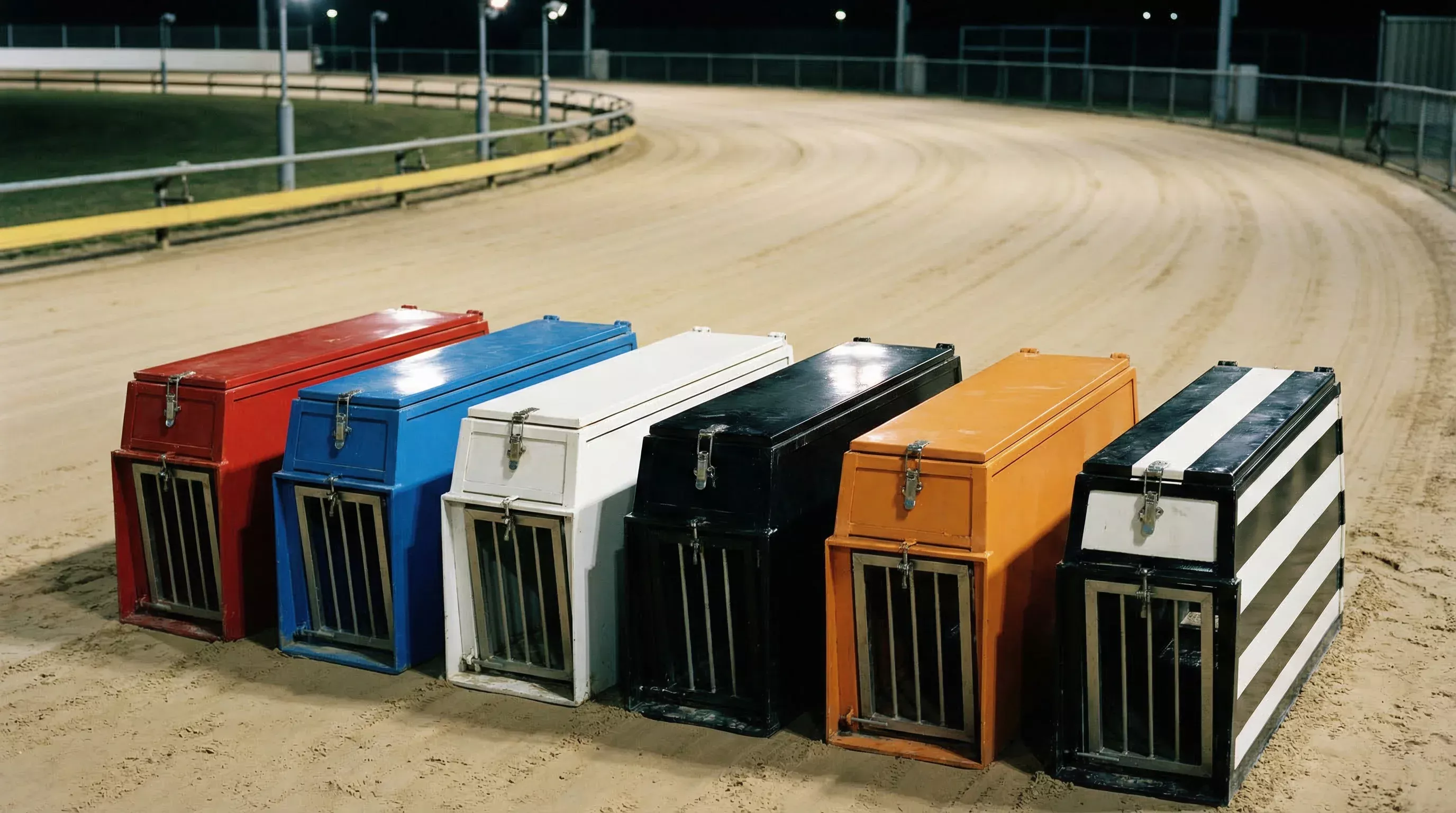
The Numbers Behind Sunderland’s Six Boxes
Every greyhound race starts in the same way: six dogs in six traps, lids lifting simultaneously, and a mechanical hare pulling them into the first bend. What varies — enormously — is how much the starting position matters. At some UK tracks, the inside trap wins significantly more often than the outside. At others, a middle draw holds a quiet advantage. The trap bias profile of a track is one of the first things a serious bettor should learn, because it tells you whether you are fighting the geometry or working with it.
Sunderland is unusual. Its trap statistics are among the flattest in the country, with each of the six boxes producing win rates close to the theoretical even split. That does not mean trap draw is irrelevant — it means the advantage is smaller and more nuanced than at most venues. Understanding why Sunderland’s numbers look the way they do, and what those numbers actually mean for race-by-race analysis, is what separates reading the data from merely looking at it.
Trap Distribution Data: Percentage Breakdown Per Trap
The headline number at Sunderland is this: each trap wins approximately 17% of races over a large sample. In a perfectly balanced six-trap system, the theoretical expectation is 16.67% per box. Sunderland comes remarkably close to that figure across all six positions, making it one of the most evenly distributed tracks in British greyhound racing.
To appreciate what that means, it helps to see what the numbers look like in practice. Trap 1, the inside box closest to the rail, tends to produce a win rate in the region of 16 to 18 per cent at Sunderland. Trap 2 sits in a similar band. Traps 3 and 4, the middle draws, hover around 17 per cent. Trap 5 and Trap 6, the wide runners, also land in the same range. The variation between the best and worst performing trap at Sunderland is typically two to three percentage points — a gap so small that it can shift from one racing season to the next depending on the dogs in the grading pool.
Compare that to the national picture and the contrast is stark. Across many UK tracks, Trap 1 pulls away from the field with win rates that can reach 20 per cent or higher, while Trap 6 dips below 14 per cent. The spread between inside and outside can be six or seven percentage points — a structural advantage that no amount of form analysis can overcome consistently. At those tracks, a dog drawn in Trap 1 has a built-in edge before a stride is taken.
At Sunderland, that built-in edge barely exists. The data — gathered across thousands of races over multiple years — shows that no single trap is a reliable positive or negative. A dog drawn wide has roughly the same chance as one drawn tight, all else being equal. That phrase, “all else being equal,” is doing important work, though. In practice, all else is never equal: dogs vary in trapping speed, bend technique, and running style. But the track itself is not tilting the field. The geometry of Sunderland’s bends, the length of the run-up to the first turn, and the width of the circuit conspire to produce a surface on which the starting position is closer to neutral than at virtually any other licensed venue.
The data behind these figures is not static. Services like Greyhound Stats UK update trap percentages as new results flow in, and seasonal variation does occur. A streak of fast-breaking dogs concentrated in certain traps can temporarily skew the percentages for a given period. Over a rolling twelve-month window, however, the pattern at Sunderland is consistent: flat, balanced, and resistant to the biases that define other tracks. Independent tracking of these numbers matters, and it relies on the kind of data infrastructure that the sport’s governing bodies have not always funded adequately. As GBGB Chief Executive Mark Bird has acknowledged, the voluntary levy that bookmakers pay remains below the level needed to safeguard the sport’s standards comprehensively — and that includes the statistical transparency that allows bettors to verify trap fairness for themselves.
Fair Track Analysis: Why Roughly 17% Per Trap Is Unusual
A flat trap distribution is not the norm in greyhound racing. It is the exception. Across UK tracks, Trap 1 averages a win rate of around 18 to 19 per cent — consistently above the 16.67 per cent that pure chance would produce. The reason is mechanical: the inside trap is closest to the rail, and the rail provides shelter through the first bend. A dog on the inside has a shorter path around the curve, faces less buffeting from rivals, and can settle into its stride earlier. That advantage compounds over the race, particularly at shorter distances where the first bend arrives quickly.
So why does Sunderland escape this pattern? The answer lies in a combination of track design factors rather than any single cause. The run-up distance to the first bend is relatively generous — 93 metres at the standard 450m trip — which gives all six dogs time to reach racing speed before the turn. At tracks with shorter run-ups, the inside dog arrives at the bend with a positional advantage simply because it had less distance to cover. At Sunderland, the longer straight dilutes that effect. By the time the field hits the bend, the dogs are more spread out and less dependent on the rail for protection.
The circumference of the track also plays a role. Sunderland’s circuit measures 378 to 379 metres, placing it in the middle range for UK venues. Larger tracks tend to have wider, more sweeping bends that allow outside runners to maintain speed without losing as much ground. Smaller, tighter tracks punish the outside disproportionately. Sunderland’s geometry sits in a zone where the bends are neither so tight that the inside dominates nor so wide that the outside is neutralised. The result is a track where the physical advantage of any given trap is marginal — present, perhaps, but too small to show up as a consistent bias over hundreds of races.
There is also the surface to consider. All-weather sand offers consistent grip regardless of position on the track. On some surfaces, the inside lane can become worn or uneven, creating patches that favour or disadvantage dogs running close to the rail. Sand, regularly maintained and raked, produces a more uniform running surface across the width of the circuit. That uniformity removes one more variable that might otherwise create a trap bias.
The practical upshot for anyone studying Sunderland results: you can focus your analysis on the dog rather than the draw. At a biased track, a strong dog drawn wide is fighting two opponents — its rivals and the geometry. At Sunderland, it is fighting only its rivals. That distinction matters enormously when you are assessing form and deciding where the value lies.
Trap Strategy Applied: What Flat Stats Mean for Your Bets
Knowing that Sunderland’s traps are balanced is valuable. Knowing what to do with that information is more valuable still. The flat distribution changes the way you should approach race analysis at this track compared to venues where trap bias is a dominant factor.
At a biased track, the starting point for any race assessment is the trap draw. You identify which dogs have favourable positions, adjust your expectations accordingly, and often find that the market has already priced in the bias — Trap 1 dogs are shorter in the betting, Trap 6 dogs are longer. At Sunderland, the market cannot lean on trap bias as a crutch, and neither should you. The starting point here is form, not position.
That said, flat aggregate stats do not mean trap draw is meaningless in every individual race. The 17% average is a figure drawn from thousands of races across all distances and grades. Within that sample, there are pockets where trap position does matter. Sprint races at 261m are the clearest example: the single-bend format amplifies the benefit of an inside draw, even at a track as balanced as Sunderland. If you are betting the 261m card, weight the trap draw more heavily than you would for a 450m or 640m race at the same venue.
Another practical application: dogs switching traps between races. At a biased track, a dog moved from Trap 5 to Trap 1 receives a measurable upgrade, and the market usually notices. At Sunderland, the same move matters less. If a dog’s form has been poor from Trap 5, moving to Trap 1 is unlikely to be the cure. Instead, look at why the form was poor — was it trapping slowly, encountering interference, or simply outclassed? The flat trap stats at Sunderland force you to dig deeper, which is inconvenient but ultimately produces better analysis.
There is a broader principle at work here. Balanced trap stats remove a layer of noise from the data. At tracks with strong biases, you are constantly adjusting for the effect of the draw — discounting a poor run from a bad trap, inflating a good run from a good one. At Sunderland, the adjustment is minimal. A third-place finish is a third-place finish, more or less regardless of the starting box. That clarity makes Sunderland one of the most honest tracks in the country for form students: what you see in the results is closer to what actually happened, with less distortion from the geometry.
Sunderland Dogs Trap Stats — More on this topic at sunderland dogs results.
See also Sunderland Greyhound Form Guide.
