Sunderland Greyhound Racecard Explained: How to Read Today's Card
Best Greyhound Betting Sites – Bet on Greyhounds in 2026
 Available in US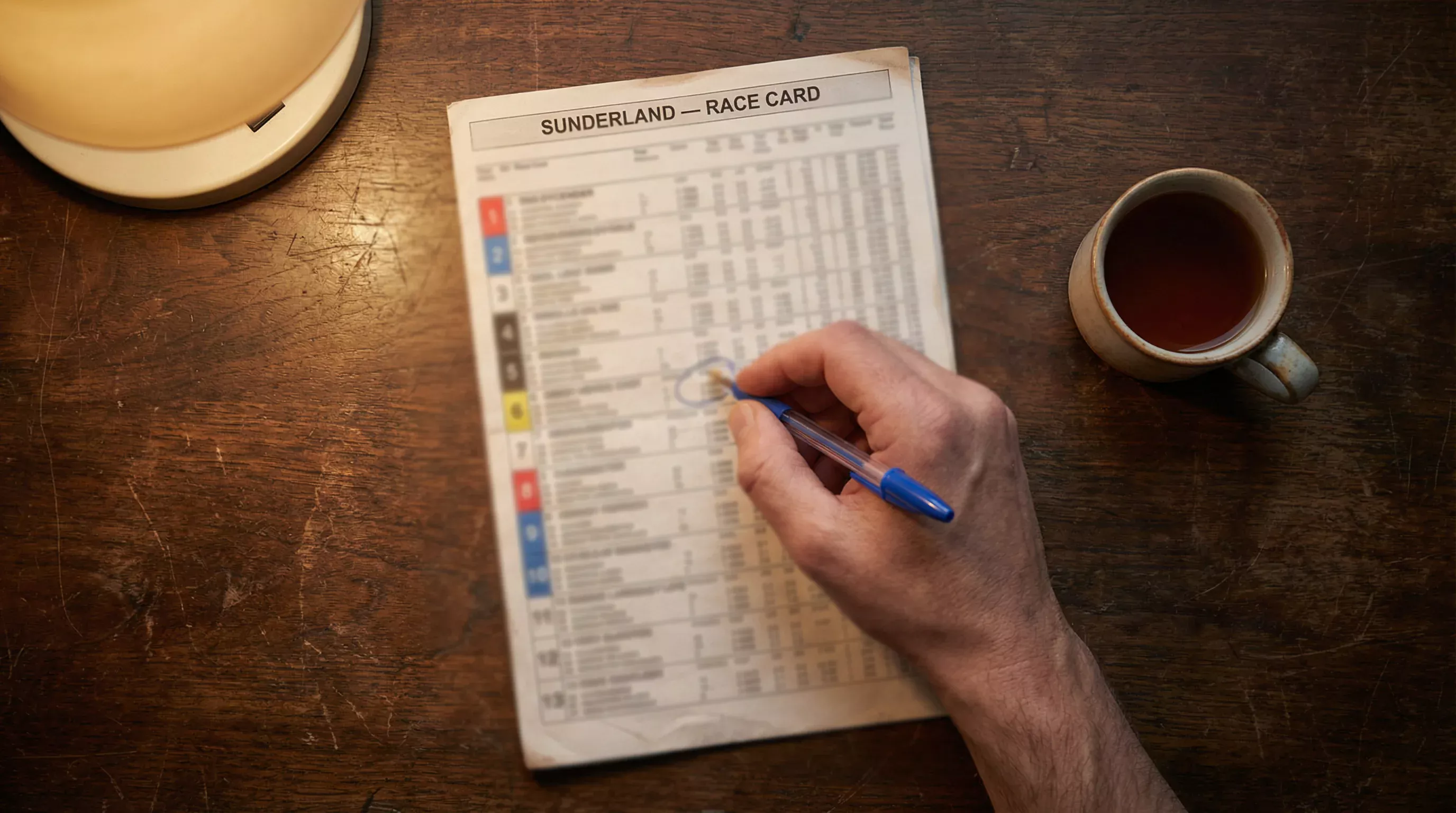
Introduction
A greyhound racecard is not a betting slip and it is not a form guide, though it contains raw material for both. It is a structured document — part timetable, part biography, part data sheet — and at Sunderland Greyhound Stadium every line on that card carries information that separates a considered selection from a stab in the dark.
What makes Sunderland’s card worth studying on its own terms? The stadium operates four fixtures a week across four distinct distances on an all-weather sand surface, and the card must compress all of that into a readable format. Trap draws, form figures stretching back six runs, grade designations, sectional splits and comment codes all share the same page. For a newcomer, the density can feel like opening a spreadsheet meant for someone else. For a regular, the danger is complacency — skimming familiar columns and missing the detail that actually matters.
Joanne Wilson, General Manager at Sunderland Greyhound Stadium, has noted that the fixture list is designed to offer “a strong mix of graded, open and competition races for racegoers to enjoy.” That variety is reflected directly in the racecard. A Monday afternoon BAGS card and a Friday night open-race programme look different in structure and in what they demand from the reader. This guide walks through every element — field by field, symbol by symbol — so that the next time you open a Sunderland PDF card, nothing on it is a mystery.
Sunderland’s PDF Format — Layout and Download
Sunderland publishes its racecards as downloadable PDF documents, typically available on the official stadium website from the morning of each race day. The format has remained deliberately conservative — a single-page-per-race layout with a fixed grid of columns — and that consistency is actually an advantage. Once you learn where each data field sits, you can scan a twelve-race card in minutes rather than hunting for information scattered across a flashier interface.
Each race on the card occupies its own block. At the top of the block you will find the race number, the scheduled off time, the distance and the grade. Sunderland runs four distances — 261 metres, 450 metres, 640 metres and 828 metres — on a track with a circumference of approximately 378 metres and an Outside McGee hare system. Knowing the distance before you even look at the dogs matters because it determines which form data is relevant: a dog’s 450-metre calculated time is irrelevant when the race is over 261 metres.
Below the race header sit six rows, one for each trap. The columns from left to right typically include the trap number and colour, the dog’s name, the trainer, the dog’s weight at last weigh-in, form figures for the previous six runs, the best recent time at this distance, any sectional data the card carries and sometimes a brief comment code. Not every card includes every column — BAGS daytime cards sometimes abbreviate the sectional data — but the core fields are always present.
The PDF format also carries a quiet advantage over live web racecards. It is a snapshot frozen at the point of publication. If a dog is withdrawn or a reserve is called up after the card goes live, the PDF will not reflect the change, but it does preserve the original intended field. That matters for analysis: if you are tracking trap draws or grade patterns over weeks, the PDF gives you a consistent baseline document, unaffected by late amendments that web platforms update silently.
Where do you actually find the card? The primary source is the Sunderland Greyhound Stadium site under its racing section. Several third-party platforms — including Racing Post Greyhounds, Timeform and SIS — also host Sunderland racecards, sometimes with additional data overlays such as predicted times or speed ratings. The official PDF is the cleanest starting point, though, and it is free. Downloading it to a tablet before an evening meeting is a habit worth forming: you avoid buffering issues, you can annotate it and you have a record for post-race review.
One formatting detail that catches people out: the PDF card lists trap colours by standard GBGB convention, and the physical jackets at Sunderland match. If you are watching on a stream and cross-referencing the card, the jacket colour is your fastest identification method — considerably faster than squinting at names on a grainy feed. The full colour-to-trap mapping is covered in the trap draw section below.
Form Figures Decoded — Last Six Runs and What Each Symbol Means
The form figures column is the most information-dense section on any greyhound racecard, and at Sunderland it follows the standard GBGB format: six characters reading left to right, each representing one race, from the most recent run on the right to the sixth-most-recent on the left. Understanding this column is non-negotiable if you want to do anything beyond picking a name you like.
Each digit represents the dog’s finishing position in that race: 1 through 6. A dog showing 111111 has won its last six starts — a rare sight outside the lowest grades. More commonly you will see mixed sequences like 342163, and the trick is reading the trend rather than the average. A sequence of 654321 tells a very different story from 123456, even though both contain the same numbers. The first dog is improving sharply; the second is deteriorating. Direction matters more than arithmetic mean.
Letters interrupt the numbers in specific situations. The most common are:
T — the dog fell (trapped or stumbled at the traps). This is mechanically different from a poor run. A fall tells you nothing about the dog’s current ability and everything about its luck. Some punters dismiss falls entirely; others watch for dogs that fall repeatedly, which can indicate a trapping problem.
F — fell during the race. More serious than a trap stumble. A mid-race fall often involves interference and can leave a dog shaken for subsequent runs. At Sunderland, where the bends on the 450-metre standard course come up quickly — the run to the first turn is 93 metres — crowding into the first bend is the most common cause of falls.
D — disqualified. This can mean the dog was impeded or caused interference and was demoted. The card does not usually explain which, so you need to check the full result for that race separately.
S — slipped at the traps. The dog was slow to leave and lost ground immediately. Like a fall, a single slip is often random. Two or three in six runs is a pattern.
B — brought down by another dog. No fault of its own. This is arguably the most forgiving code on the card because it implies the dog was in a good position before being taken out by interference.
Beyond position numbers and letter codes, some cards include a small superscript or suffix indicating the distance the dog won or lost by. You might see “12½” meaning the dog won by two and a half lengths, or “3¾” meaning it finished third, three-quarters of a length behind the second dog. Not all PDF cards carry this level of detail, but when they do, it transforms a bare finishing position into a performance measurement. Winning by a neck is not the same as winning by five lengths, even though both read as “1” in the raw form figures.
What matters most when reading Sunderland form is filtering by distance. The card shows the last six runs regardless of where they took place or over what trip. A dog that ran its previous three races at Romford over 400 metres and is now stepping up to 640 metres at Sunderland is effectively a different animal. The form figures are real, but they describe a different question. Serious card readers note which runs were at Sunderland and at the same distance, and weight those far more heavily than away form over unfamiliar trips.
The origin of the dogs adds another layer. According to the GBGB Progress Report, 84.5% of newly registered greyhounds in 2024 were bred in Ireland and 15.5% came from British litters. Irish imports often arrive at British tracks with trial form only — no race form in the GBGB system. On the card, a dog with fewer than six form entries may show dashes or blanks for the missing runs. A single digit followed by five dashes does not mean the dog is unproven; it means the card cannot tell you what it did before arriving in the UK. Checking Irish form separately is an extra step, but it can reveal a dog with genuine ability that the bare racecard undersells.
Trap Draw on the Card — Position, Colour and Rail Bias
The trap number is the first piece of information on each row of the racecard, and it is the single data point that most casual punters either ignore or misunderstand. At a six-box greyhound track the theoretical win rate for each trap is 16.67% — one in six. In reality, trap bias exists at almost every stadium in Britain. The inside boxes benefit from a shorter path to the rail; the outside boxes avoid early crowding but travel further on the bends. The question is always how severe the bias is at this specific track.
Sunderland is one of the most balanced circuits in the country. According to Greyhound Stats UK, each trap at the stadium wins approximately 17% of races — remarkably close to the theoretical expectation. This near-parity is unusual. Across UK tracks generally, Trap 1 tends to produce a slightly elevated win rate of 18–19%, largely because the inside rail offers protection from interference on the first bend. At Sunderland that advantage is muted, which has a direct consequence for how you use the card.
If you are studying a racecard at a venue with a strong Trap 1 bias, draw is itself a form factor — you can upgrade a dog drawn inside and downgrade one drawn wide regardless of its recent results. At Sunderland you cannot lean on that shortcut. A dog in Trap 6 is not meaningfully disadvantaged relative to Trap 1 in aggregate data, which means your assessment has to rely more heavily on the other fields: form, sectional times, grade and trainer. The fairness of the track actually demands more work from the card reader, not less.
That said, distance modifies the equation. Trap draw matters most in sprint races over 261 metres where the entire contest is essentially a dash to the first bend and back. At that distance, an early rail position can be decisive not because of statistical bias but because there are fewer bends to recover from a poor start. Over 828 metres — Sunderland’s marathon trip — trap draw is diluted by more than two full laps of the circuit. By the second lap, starting position is ancient history and stamina becomes the only relevant variable.
On the card itself, the trap number is accompanied by its standard GBGB colour. The mapping is universal across licensed tracks: 1 is red, 2 is blue, 3 is white, 4 is black, 5 is orange and 6 is black-and-white stripes. These colours are not decorative. They are functional identifiers used by the camera operators, the commentators and the photo-finish judges. When you are watching a live stream of a Sunderland race, the jacket colour is the fastest way to follow your selection — considerably faster than reading the name off a moving greyhound at 40 miles per hour.
Some experienced card readers annotate their racecards with running-line notes from previous races. A dog that consistently shows early pace and rails hard into the first bend is more dangerous from Trap 1 or 2 than from Trap 5 or 6, regardless of what the aggregate trap data says. A wide runner that sweeps around the outside is the opposite — it actually benefits from a wider draw that keeps it clear of trouble. The trap number on the card is the starting point for this analysis, but the finish line is understanding how each individual dog uses the space it is given.
Grades on the Racecard — What A1, B3 and D4 Tell You
Every graded race at Sunderland carries a grade designation on the card, and the system follows the standard GBGB structure: letters from A down to D indicate the tier, and numbers from 1 to around 4 indicate the subdivision within that tier. A1 is the highest graded level. D4 is the lowest. A dog racing in A1 is faster, more proven and running against tougher opposition than one in D4. That much is straightforward. The subtlety lies in what the grade tells you about the dog’s trajectory and what it does not tell you at all.
Grades are assigned based on a dog’s recent times and finishing positions at a specific distance. A dog that wins two consecutive races at D3 level will typically be promoted to D2 or even D1 depending on the times it posted. One that finishes in the bottom half repeatedly may be dropped. The system is semi-automatic — the racing manager has some discretion — but the general principle is meritocratic: perform well and you move up; struggle and you move down. On the racecard, the grade is printed alongside the race header, so you know before studying any individual dog whether you are looking at a high-class contest or a lower-tier affair.
Why does this matter for reading the card? Because grade context changes the meaning of form figures. A dog showing 321432 in A2 company is performing at a fundamentally higher level than one showing 111111 in D4. The first dog is competing against faster, more experienced rivals and holding its own. The second is dominating weak opposition and may be about to meet a reality check when it gets promoted. If you look at form figures without checking the grade, you are comparing numbers without units.
Sunderland also hosts open races and Category One competitions that sit outside the grading ladder entirely. The two flagship events — the ARC Grand Prix in April and the ARC Classic in November — are open to greyhounds from across the country and carry the highest prize money at the stadium. The Grand Prix offers £12,500 to the winner and holds Category One status, the top classification in UK greyhound racing. On the racecard, open races are marked differently from graded events — typically with the word “Open” or the competition name replacing the grade code. When you see that designation, you know the field has been selected on merit and invitation rather than through the regular grading system.
One practical point that the racecard does not spell out: grade designations are track-specific. An A3 dog at Sunderland is not necessarily the same standard as an A3 dog at Romford or Nottingham. Each stadium grades its own pool of active greyhounds, and the depth of that pool varies. Sunderland has a healthy base of active dogs, which means its grading tiers are relatively well-populated. At smaller venues with thinner pools, the gap between grades can be narrower. If a dog transfers in from another track, its new grade at Sunderland will be set by the racing manager based on trial times and away form, not by simply carrying across the old grade. The racecard shows the Sunderland grade, and that is the one that counts for the race you are studying.
Sectional Data on the Card — Splits, Calculated Times and Comment Codes
If form figures tell you what happened and grades tell you the level at which it happened, sectional data tells you how it happened. This is the most analytically valuable column on the Sunderland racecard and the one that most casual punters skip because the numbers look technical. They are technical. They are also surprisingly readable once you know the framework.
Sectional times — or splits — break a race into segments timed individually. At Sunderland, where the standard 450-metre trip features a run of 93 metres to the first bend, the first sectional captures the dog’s early pace: how quickly it leaves the trap and reaches that turn. The remaining sections time the dog through the bends and the home straight. A dog that posts a fast first sectional but a slower closing split is an early-pace type that may tire late. One that shows moderate early speed but a strong final section is a closer — a dog that picks up ground when others fade. Neither profile is inherently better; both matter because they tell you where a dog will be positioned during the race, not just where it finished.
Calculated time — commonly abbreviated to CT on the card — is a derived figure that adjusts a dog’s raw finishing time for factors like the going, the weight and the running position. The concept is borrowed from horse racing and serves a similar purpose: it gives you a standardised time that can be compared across different days and conditions. If a dog ran 28.45 seconds last Wednesday on going that was running half a second slow, its calculated time would be adjusted downward to something like 27.95. The racecard may display the raw time, the calculated time or both, depending on the card publisher.
For Sunderland specifically, the all-weather sand surface means the going varies less dramatically than at a turf horse-racing track, but it still changes. Rain saturates the sand differently from dry cold, and maintenance cycles — the track is harrowed regularly to maintain consistency — create subtle speed variations from one meeting to the next. Calculated times smooth out those fluctuations and let you compare a performance from a wet Monday in January with a dry Friday in July on a roughly level footing.
Comment codes appear as short abbreviations attached to a dog’s form line, and they describe notable incidents during the race. Common codes include “Crd” (crowded), “Bmp” (bumped), “Ck” (checked — lost ground due to interference), “W” (wide — ran wider than ideal through a bend), “RIs” (raced on the inside rail) and “SAw” (slow away — lost ground at the traps). These codes are compressed storytelling. A dog that finished fourth but carries “Ck 1” and “Bmp 2” in its comment line was interfered with at the first and second bends, which means its finishing position flatters neither its ability nor the dogs that beat it. Without reading the comment code, you would see a “4” in the form and move on. With it, you see a dog that was travelling well and got stopped.
The real analytical payoff comes from combining all three layers — splits, calculated time and comment codes — for the same run. Imagine a dog that posted a fast first sectional, a slow closing split, finished third and carries the comment code “W 3” (ran wide at the third bend). The story writes itself: it broke well, was travelling strongly, got pushed wide on the final turn, lost momentum and could not recover. That dog is probably better than a bare “3” in the form column suggests. If it draws a better trap next time — one that lets it hold the rail — its chance improves meaningfully.
Racecards vary in how much sectional data they carry. The official Sunderland PDF tends to include at least the finishing time and grade. Third-party platforms like Timeform and Racing Post often add calculated times, sectional splits and comment breakdowns. Building a habit of cross-referencing the official card with one detailed platform gives you the fullest picture without paying for multiple subscriptions.
Putting It Together — A Worked Example from a Real Sunderland Card
Theory is useful. Application is better. Let us walk through a hypothetical but realistic race on a Sunderland Friday night card, applying every element discussed above, to show how the pieces connect when you actually sit down with a racecard and a pen.
The race is a B2 graded event over 450 metres. That immediately tells you several things. B2 is mid-upper tier — these are competent dogs that have either been promoted from the C grades or dropped from A level. The 450-metre distance is the standard trip at Sunderland, so most dogs in this grade will have multiple runs at this distance and track. Form figures should be directly comparable.
Trap 1 (Red): Form reads 321141. The dog has been competitive in five of its last six runs, winning twice. Recent form is trending positively — the last three reads are 1, 4, 1, suggesting it bounced back from a bad run. Weight is 31.2 kg, close to its average. Best time at this distance is 27.89 seconds. Comment on the “4” run shows “Ck 1, Bmp 2” — it was checked at the first bend and bumped at the second, which explains the anomalous result. Verdict: a genuine contender that had one bad-luck run in an otherwise strong sequence.
Trap 2 (Blue): Form reads 665543. This is a dog going backwards. Its best result in six runs is third, and the trend is upward only if you squint — 4, 3 from the recent runs. Best time is 28.21 seconds, significantly slower than Trap 1. No notable comment codes. The dog appears to be in the wrong grade and may be due a drop. In a B2 race, it looks outclassed.
Trap 3 (White): Form reads 111213. Dominant recent form with four wins from six. But here is where grade context matters. The “1, 1, 1” runs were all in C1 grade — the dog has just been promoted to B2 and is stepping up in class for the first time. The two defeats (a second and a third) came against B-grade opposition in open trials. Best time is 28.02. This dog has ability but is unproven at this level. The racecard tells you why caution is warranted.
Trap 4 (Black): Form reads 2—– (one run, five blanks). This is an Irish import with a single British race under its belt, finishing second. The dashes indicate no prior GBGB form. Weight is 33.8 kg — heavier than the others, which is typical of Irish-bred greyhounds that are often bigger-framed. The card does not show Irish trial times, so you have limited data. According to GBGB registration data, around 84.5% of new greyhounds entering British racing come from Ireland, so encountering this profile on a Sunderland card is routine. What the card cannot tell you is whether this dog ran 28.50 or 27.50 in its Irish trials. That requires separate research, and it could change your entire assessment.
Trap 5 (Orange): Form reads 232322. Consistent but never wins. Second place four times in six runs. Best time is 27.95 — quick — and the comment codes show “RIs” in several runs, meaning the dog races on the inside rail. That running style suits an inside draw better than Trap 5. From this box, it will need to navigate across to find the rail, which risks early interference. This is a dog whose ability is not in question but whose draw tonight is working against its preferred style. At a track with strong Trap 1 bias, you might dismiss it outright. At Sunderland, where trap distribution is approximately 17% per box, the disadvantage is real but modest.
Trap 6 (Black-and-White): Form reads 114211. Recent winner, two wins and a second from the last three runs. Best time is 27.82 — the quickest in the field. Comment codes show “W 2, W 3” in earlier runs, meaning it tends to run wide through the bends. A wide runner from Trap 6 is actually a comfortable pairing: the dog will break to the outside naturally and not need to cross traffic. If it has the pace to lead into the first bend — and a 27.82 best time at this distance suggests it does — Trap 6 is a less disadvantaged draw for this particular animal than the raw trap number implies.
Reading the card this way takes perhaps three minutes per race. Over a twelve-race Sunderland fixture, that is half an hour of preparation. The alternative — glancing at the top form figure and backing the name you recognise — takes ten seconds but misses everything the racecard is trying to tell you. Every line on the Sunderland racecard carries weight. The purpose of this guide is to make sure none of it goes unread.
Sunderland Greyhound Racecard Explained — More on this topic at sunderland dogs results.
See also Sunderland Dogs Fixtures and Schedule.
